

Climate change is not a discrete issue; it's a symptom of larger problems. Fundamentally, our society as currently designed has no future. We're chewing up the planet so fast, in so many different ways, that we could solve the climate problem tomorrow and still find that environmental collapse is imminent.
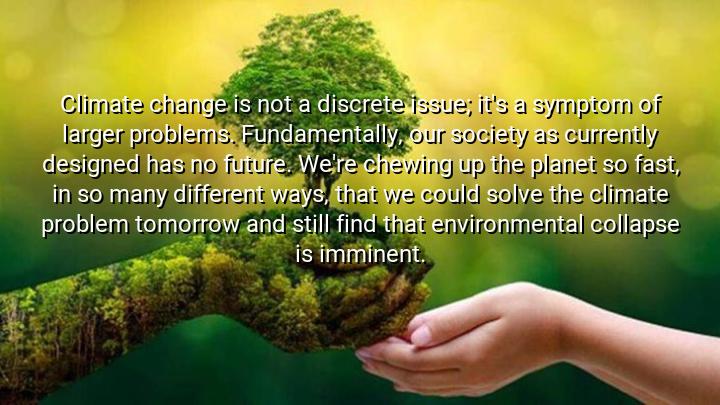




The quote, "Climate change is not a discrete issue; it's a symptom of larger problems. Fundamentally, our society as currently designed has no future. We're chewing up the planet so fast, in so many different ways, that we could solve the climate problem tomorrow and still find that environmental collapse is imminent," comes from Alex Steffen, an American futurist, environmental thinker, and writer known for his work on sustainability and future-oriented solutions to global challenges. Steffen frequently explores the interconnectedness of environmental, social, and economic systems, emphasizing that addressing one issue in isolation is insufficient.
At its core, Steffen is arguing that climate change cannot be treated as an isolated problem. He frames it as a symptom of broader systemic issues in modern society, including overconsumption, resource depletion, and unsustainable patterns of industrialization and development. Even if climate change were resolved quickly, the underlying structural flaws of society could still drive environmental collapse, highlighting the urgency of rethinking societal design.
The origin of this quote reflects Steffen’s broader advocacy for systems thinking in environmental policy and activism. By identifying climate change as a manifestation of deeper problems, he encourages individuals, policymakers, and communities to address root causes rather than only focusing on surface-level solutions. His perspective emphasizes that long-term sustainability requires holistic reform across multiple sectors of society.
In summary, this quote serves as both a warning and a call to action. Steffen underscores that solving climate change alone is insufficient; society must fundamentally reimagine its structures, consumption habits, and relationship with the planet. The statement challenges readers to recognize the interconnectedness of global crises and to pursue solutions that are comprehensive, forward-thinking, and deeply systemic.

AAdministratorAdministrator
Welcome, honored guests. Please leave a comment, we will respond soon