

Children have neither a past nor a future. Thus they enjoy the present, which seldom happens to us.
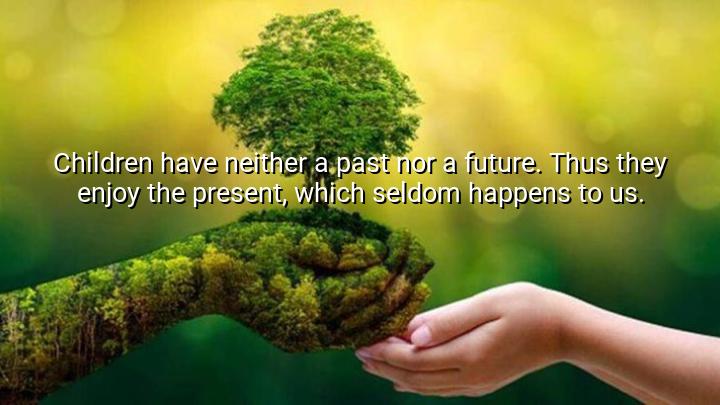




In this quote, Jean de la Bruyère, a French philosopher and moralist, reflects on the nature of childhood and its contrast with the experience of adults. He suggests that children are not burdened by the concerns of a past or future, which allows them to fully immerse themselves in the present moment. Unlike adults, who are often preoccupied with memories or anxieties about what lies ahead, children can experience life with an innocence and freedom that makes them more attuned to the now.
La Bruyère’s statement highlights the idea that as we grow older, we become consumed by responsibilities, regrets, and expectations, which often prevent us from appreciating the present. While adults are constantly planning, reflecting, or worrying, children are able to live in the moment, which is often seen as a blissful and unencumbered state. La Bruyère’s words suggest that this ability to live in the present is something adults can learn from children, who inherently embrace the joy of the now without the weight of time.
The quote also speaks to the notion of time and how our relationship with it changes over the course of our lives. Children, according to La Bruyère, experience time in a more fluid and unstructured way, whereas adults are shaped by the pressures and constraints of a time-driven society. This difference underscores a key philosophical idea about how we perceive time, with children having a purer, untainted view, while adults struggle to find balance between the past and the future.
Ultimately, La Bruyère’s quote invites us to reflect on the way we manage our own relationship with time and the present. It serves as a reminder of the value of being more present and mindful, much like children, who show us how to appreciate the moment without being overshadowed by the weight of what has been or what is to come.

AAdministratorAdministrator
Welcome, honored guests. Please leave a comment, we will respond soon