

Censorship is never over for those who have experienced it. It is a brand on the imagination that affects the individual who has suffered it, forever.
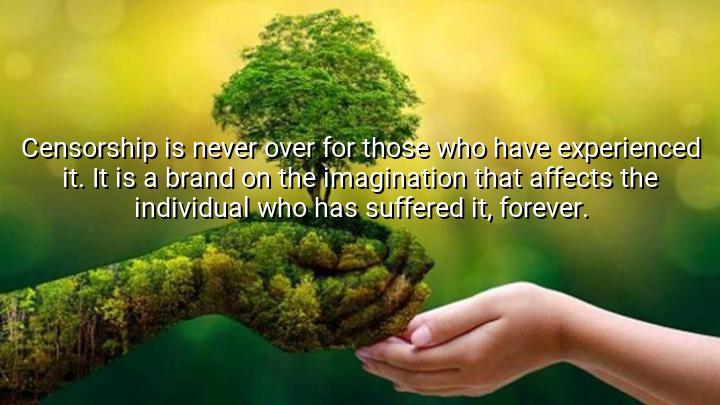




The quote "Censorship is never over for those who have experienced it. It is a brand on the imagination that affects the individual who has suffered it, forever" by Noam Chomsky underscores the enduring psychological and emotional impact of censorship on an individual. Chomsky, a renowned linguist, philosopher, and social critic, suggests that once a person has been subjected to censorship—whether through the suppression of their ideas, expression, or access to information—it leaves a lasting mark on their creativity and thought processes. The imagination, which is central to how we understand and engage with the world, is fundamentally altered by the experience of censorship.
Chomsky emphasizes that the effects of censorship are not just temporary or situational. Instead, it creates a deep scar that shapes an individual’s perception and approach to ideas, expression, and communication. This "brand on the imagination" speaks to how deeply censorship can alter one's ability to think freely and creatively, instilling a sense of self-censorship or caution that persists long after the external pressures have subsided. The psychological effects extend beyond the immediate experience, influencing how one engages with ideas and how open they are to exploring new or controversial thoughts.
The origin of this quote is rooted in Chomsky's broader critique of political and social systems that control or suppress freedom of speech and thought. Throughout his career, Chomsky has spoken out against various forms of censorship, from government control to corporate influence over media. He has consistently argued that censorship stifles critical thinking and prevents individuals from fully engaging with the complexities of the world. This quote encapsulates his belief in the deep and lasting consequences of limiting free expression.
Ultimately, Chomsky’s quote highlights the long-term and transformative effects of censorship on an individual’s intellectual and creative freedom. It serves as a reminder that the imagination—vital to innovation and personal expression—cannot be fully free if it is constrained by external forces that suppress the flow of ideas. Censorship, in this sense, not only limits expression but fundamentally alters the way we think and perceive the world, creating a permanent barrier to intellectual and creative growth.

AAdministratorAdministrator
Welcome, honored guests. Please leave a comment, we will respond soon