

By religion, then, I understand a propitiation or conciliation of powers superior to man which are believed to direct and control the course of nature and of human life.
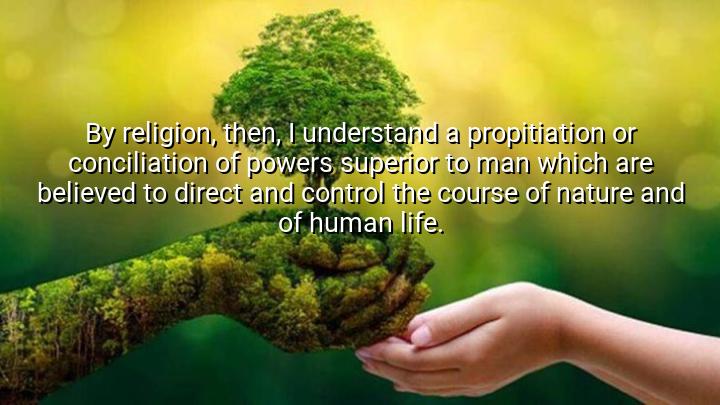




The quote by James G. Frazer, “By religion, then, I understand a propitiation or conciliation of powers superior to man which are believed to direct and control the course of nature and of human life,” defines religion as a system in which humans attempt to appease or gain favor from supernatural forces. Frazer emphasizes that people have historically believed in powers beyond human control—whether gods, spirits, or other mystical forces—that influence both natural phenomena and human destiny. The statement reflects a perspective that religion functions as a mechanism for managing uncertainty and exerting influence over life.
The origin of this quote comes from James G. Frazer, a Scottish anthropologist and folklorist, best known for his seminal work The Golden Bough. Frazer studied myths, rituals, and religious practices across cultures, exploring how humans attempt to understand and control the world through rituals and beliefs. This definition of religion reflects his scholarly approach to analyzing human behavior, culture, and the development of religious thought.
At its core, the quote underscores the functional role of religion in human society. By describing religion as a form of propitiation or conciliation, Frazer suggests that religious practices are designed to mitigate uncertainty, reduce fear, and establish a sense of order in a world perceived as unpredictable. It highlights religion as both a cultural and psychological tool for coping with life’s challenges.
Ultimately, James G. Frazer’s statement serves as a foundational explanation for understanding religion from an anthropological perspective. It encourages a recognition of how humans historically sought to interact with and influence unseen forces, illustrating the deep connection between belief, ritual, and the human need to explain and navigate the natural and social world.

AAdministratorAdministrator
Welcome, honored guests. Please leave a comment, we will respond soon