

But what we call our despair is often only the painful eagerness of unfed hope.
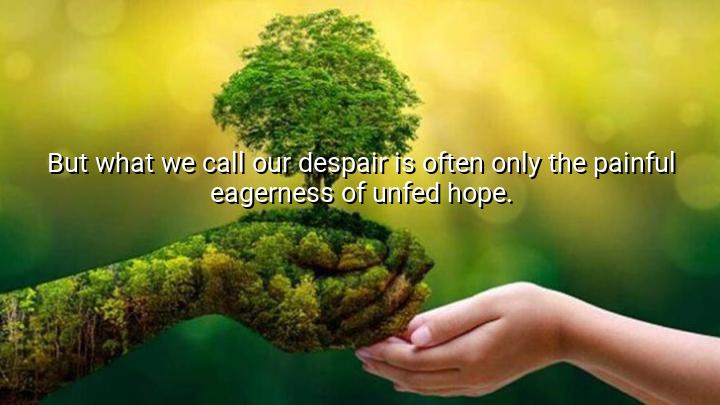




The quote "But what we call our despair is often only the painful eagerness of unfed hope" comes from George Eliot, the pen name of the British novelist Mary Ann Evans. In this statement, Eliot reflects on the emotional complexity of despair and its relationship to hope. She suggests that what we perceive as despair might actually be the intense longing and frustration that arises when hope is not fulfilled. Instead of being an absolute feeling of hopelessness, despair may stem from unfulfilled desires or unrealized expectations, where our hope is strong but unacted upon.
Eliot’s words highlight the psychological nuance of despair. Rather than being a complete absence of hope, despair can often be seen as a painful state of yearning—where there is still an underlying desire for something better, but it feels out of reach. The phrase "unfed hope" suggests that hope is like a hunger or need that is not being nourished, which leads to frustration and emotional pain.
The idea that despair is often rooted in hope challenges the conventional view that despair arises from the absence of all optimism. Eliot encourages us to reconsider the nature of our negative emotions, suggesting that despair may actually be the result of an unmet expectation rather than a complete loss of hope. This perspective shifts the way we might understand and deal with emotional pain, offering a more compassionate view of how we experience longing and frustration.
Ultimately, Eliot’s quote explores the complex interplay between hope and despair, suggesting that despair can be transformed if we learn to properly feed and fulfill our hopes. It encourages us to recognize that our emotional states are often linked to deeper, unfulfilled desires and that with the right understanding, we can better manage and address our feelings.

AAdministratorAdministrator
Welcome, honored guests. Please leave a comment, we will respond soon