

But the whole point of the Sixties was that you had to take people as they were. If you came in with us you left your class, and colour, and religion behind, that was what the Sixties was all about.
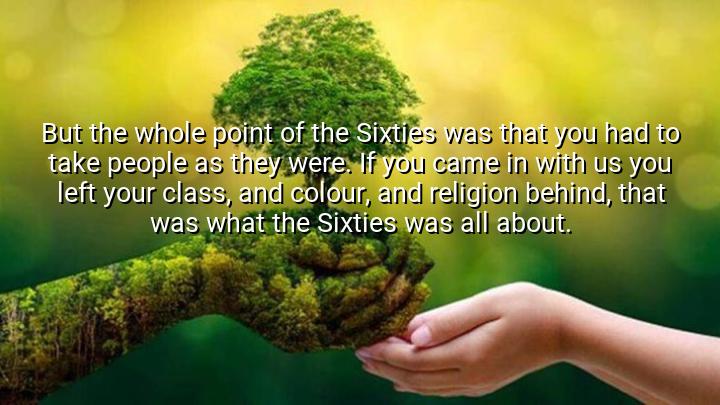




The quote by Michael Caine reflects on the social and cultural revolution of the 1960s, emphasizing a spirit of inclusivity and egalitarianism. Caine highlights that during this transformative era, individuals were encouraged to set aside distinctions such as class, colour, and religion, and instead embrace a sense of collective identity. The Sixties, in his view, were defined by a willingness to accept people as they were, fostering a community that prioritized shared experiences and values over inherited social divisions.
The origin of this quote lies in Caine’s personal reflections on growing up and working in London during the 1960s, a period marked by youth-driven change, counterculture movements, and a redefinition of traditional social norms. Influenced by music, fashion, and cinema, the decade encouraged a break from rigid hierarchies and an exploration of freedom and self-expression. Caine’s words capture the ethos of the era, where young people sought to build connections based on personality and shared ideals rather than societal labels.
By mentioning class, colour, and religion, Caine underscores the barriers that previously divided society. The Sixties challenged these divisions, promoting a meritocratic sense of belonging in which individuals could participate fully without the weight of historical or social constraints. This vision of inclusivity resonated across many spheres, from the arts and entertainment to politics and social activism, and became a hallmark of the decade’s cultural identity.
Ultimately, the quote serves as a testament to the transformative spirit of the Sixties. It reminds us that the period was not just about fashion or music, but about a deeper social consciousness—an aspiration to create a world where people were valued for themselves, not their background. Caine’s reflection captures both the hope and idealism that defined the era and continues to inspire discussions on equality and acceptance today.
If you want, I can also create a condensed version highlighting just the core ideas and keywords for quicker reference.

AAdministratorAdministrator
Welcome, honored guests. Please leave a comment, we will respond soon