

At every turn, when humanity is asked the question, 'Do you want temporary economic gain or long-term environmental loss, which one do you prefer,' we invariably choose the money.
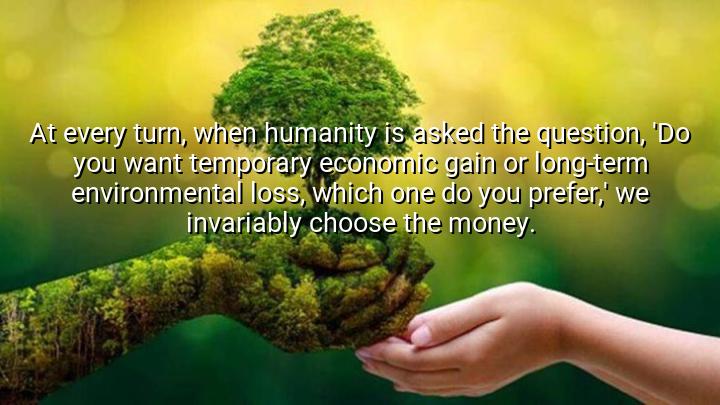




The quote by Ethan Hawke highlights the recurring conflict between economic interests and environmental responsibility. Hawke observes that when humanity faces the choice between temporary economic gain and long-term environmental loss, the tendency is to favor immediate financial benefits. This reflects a broader critique of human priorities, emphasizing how short-term thinking often outweighs concerns for sustainability and the health of the planet.
The meaning of the quote lies in its commentary on human behavior and societal decision-making. Hawke points out a pattern of prioritizing profit over environmental stewardship, suggesting that even when the consequences of environmental degradation are clear, economic incentives often dominate choices. This tension underlines the challenge of implementing sustainable policies in a world driven by consumerism and short-term rewards.
The origin of this quote comes from Hawke’s engagement with environmental advocacy and public commentary on climate change. As an actor and activist, he uses his platform to draw attention to the ways in which society systematically undervalues ecological preservation in favor of financial gain, urging reflection on the ethical and practical consequences of these decisions.
Overall, the quote serves as a warning about the trade-offs between money and the environment. Hawke encourages readers to recognize the long-term costs of prioritizing short-term economic benefits, highlighting the need for a shift toward sustainable decision-making that balances human prosperity with the health of the planet.

AAdministratorAdministrator
Welcome, honored guests. Please leave a comment, we will respond soon