

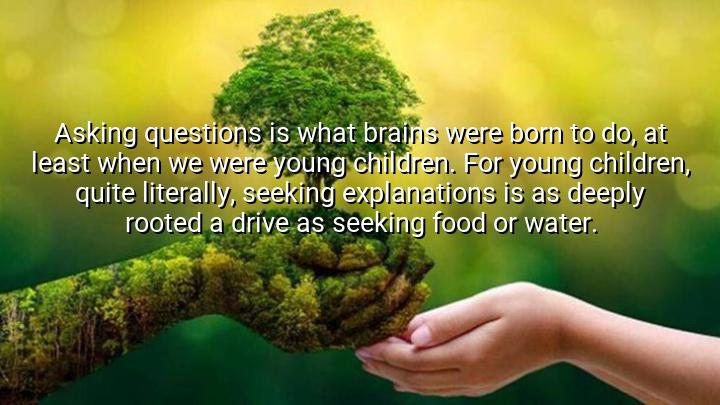
Asking questions is what brains were born to do, at least when we were young children. For young children, quite literally, seeking explanations is as deeply rooted a drive as seeking food or water.
Asking questions is what brains were
Asking questions is what brains were born to do, at least when we were young children. For young children, quite literally, seeking explanations is as deeply rooted a drive as seeking food or water.

Asking questions is what brains were
Asking questions is what brains were born to do, at least when we were young children. For young children, quite literally, seeking explanations is as deeply rooted a drive as seeking food or water.
Asking questions is what brains were
Asking questions is what brains were born to do, at least when we were young children. For young children, quite literally, seeking explanations is as deeply rooted a drive as seeking food or water.
Asking questions is what brains were
Asking questions is what brains were born to do, at least when we were young children. For young children, quite literally, seeking explanations is as deeply rooted a drive as seeking food or water.
Asking questions is what brains were
Asking questions is what brains were born to do, at least when we were young children. For young children, quite literally, seeking explanations is as deeply rooted a drive as seeking food or water.
Asking questions is what brains were

This quote by developmental psychologist Alison Gopnik underscores the natural human instinct, particularly evident in young children, to be inquisitive and continuously seek understanding. Gopnik emphasizes that the act of asking questions isn't just a learned behavior—it's something innate, intrinsic, and essential to our very nature. She states explicitly that this urge for seeking explanations is as fundamental and vital as the physical needs for food or water.

By comparing the child's desire for knowledge to basic survival needs, Gopnik highlights that curiosity is not merely casual interest but a critical, biological drive. This framing suggests that a child's constant questioning and exploration are deeply purposeful, facilitating their cognitive development, growth, and adaptation to the world around them.

Originating from Gopnik's extensive research into early childhood cognition and learning, this quote captures her broader perspective on the profound importance of nurturing curiosity in children. It also serves as a reminder to educators and caregivers to foster and value children’s questions, recognizing curiosity as a fundamental component of human intelligence, creativity, and development.

Alison Gopnik
Alison Gopnik

American - Psychologist Born: June 16, 1955

Have 0 Comment Asking questions is what brains were

AAdministratorAdministrator

Welcome, honored guests. Please leave a comment, we will respond soon

Reply.
Information sender
Leave the question
Click here to rate
Information sender
0.33910 sec| 2559.945 kb