

As told in Friendship with God, if we simply decided to believe and act as if first, we're all one, and second, life is eternal, it would render virtually everything we've done all our lives pointless.
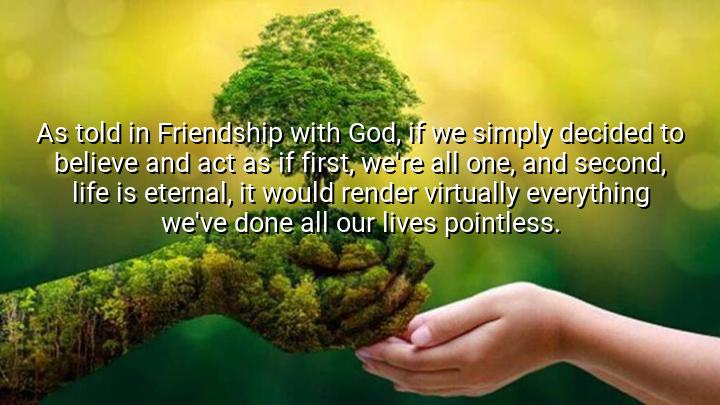




In this quote, Neale Donald Walsch explores the transformative potential of belief and spirituality in shaping our understanding of life. He suggests that if we accepted two fundamental truths—that we're all one and that life is eternal—it would render much of what we’ve done in our lives pointless. The quote implies that many of our actions, driven by fear, competition, and separation, would lose their significance if we truly embraced these deeper spiritual truths. If we realized our interconnectedness and the eternal nature of existence, our motivations and priorities would shift.
Walsch’s words challenge the conventional way of living, which often focuses on individual achievements, material success, and the notion of a finite life. He proposes that if we understood unity and the eternity of life, we might stop living in a way that prioritizes external success or fear of death. The notion that everything we have worked for might be pointless in the context of a greater spiritual truth suggests that our focus should shift towards a more holistic and compassionate way of living.
The origin of this perspective can be found in Walsch’s broader spiritual philosophy, particularly in his book Friendship with God. In this work, Walsch emphasizes the importance of recognizing a higher, universal truth that transcends individual ego and material pursuits. His ideas are influenced by concepts from various spiritual traditions, particularly those that emphasize the oneness of humanity and the eternal nature of the soul.
Ultimately, Walsch’s quote invites us to reconsider our priorities. By embracing the idea that we are all one and that life is eternal, we can shift our focus from temporary pursuits to those that foster connection, love, and understanding, seeing our lives as part of a larger, infinite whole.

AAdministratorAdministrator
Welcome, honored guests. Please leave a comment, we will respond soon