

As long as man continues to be the ruthless destroyer of lower living beings he will never know health or peace. For as long as men massacre animals, they will kill each other.
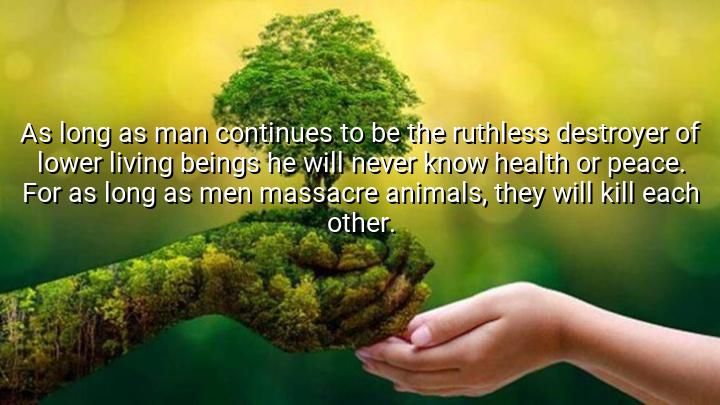




The quote by Pythagoras, "As long as man continues to be the ruthless destroyer of lower living beings he will never know health or peace. For as long as men massacre animals, they will kill each other," suggests that humanity’s treatment of animals is directly linked to its ability to achieve true peace and health. Pythagoras believed that violence toward other living beings, especially animals, breeds a cycle of harm and suffering that extends to human society. The act of killing animals for food or sport reflects a deeper moral and ethical issue, and according to Pythagoras, it also reflects a disconnection from the natural world.
Pythagoras' statement also emphasizes the idea that violence toward animals is not just a matter of ethics, but of human well-being. He argues that those who are involved in the massacre of animals carry a mindset of destruction that spills over into their relationships with other people. In this view, the lack of compassion for animals makes it difficult for people to develop the compassion and empathy necessary to live in harmony with each other, leading to conflict and war.
Furthermore, Pythagoras connects the ethical treatment of animals to the broader concept of peace and health. He suggests that if humanity truly wants to achieve inner peace and societal health, it must first recognize the interconnectedness of all life. By respecting the rights of other living beings and practicing non-violence, humans can create a more peaceful and healthy existence for themselves and for the world around them.
Originating from the philosophy of Pythagoras, a Greek philosopher and mathematician, this quote reflects his beliefs in the sanctity of life and the importance of vegetarianism. Pythagoras, known for his contributions to mathematics and his spiritual views, was also a strong advocate for ethical treatment of animals, seeing the act of eating them as morally wrong. His teachings on the connection between physical health, spirituality, and non-violence influenced later philosophical movements and continue to resonate with modern-day advocates for animal rights and peace.

AAdministratorAdministrator
Welcome, honored guests. Please leave a comment, we will respond soon