

As fears about the energy and environmental crises reach a fever pitch, we're all searching for solutions. And one possibility is that we could fix everything if we'd just shrink our population back down to about 2 billion people - which would put us roughly where we were at 80 years ago.
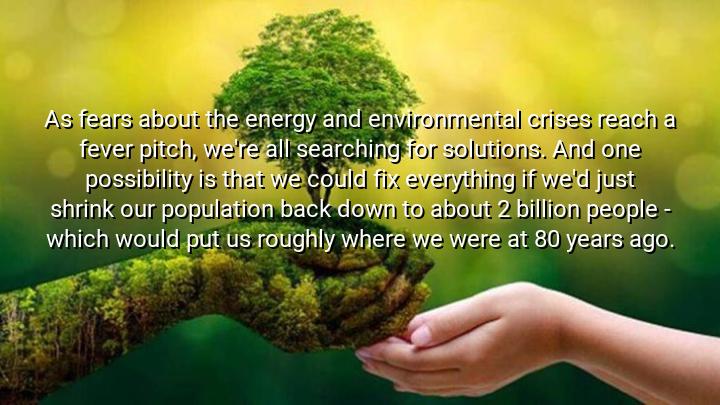




The quote "As fears about the energy and environmental crises reach a fever pitch, we're all searching for solutions. And one possibility is that we could fix everything if we'd just shrink our population back down to about 2 billion people - which would put us roughly where we were at 80 years ago" by Annalee Newitz explores the idea of population control as a potential solution to global environmental and resource issues. Newitz suggests that reducing the world’s population significantly could alleviate many of the strains on the planet's natural resources, energy consumption, and ecosystems, drawing a comparison to the global population size 80 years ago, when the world was less burdened by overconsumption and environmental degradation.
The origin of this quote comes from Annalee Newitz, a science fiction author, journalist, and editor with a focus on technology, environmental issues, and the future of human society. Newitz is known for her thought-provoking takes on how society might address pressing environmental and technological challenges. This quote reflects a more radical perspective on sustainability, suggesting that the population growth of recent decades has significantly contributed to the energy crisis and environmental degradation the world now faces.
Newitz’s comment challenges conventional solutions to global crises, such as renewable energy or green technologies, by proposing a drastic measure: reducing the human population. While this idea is extreme and controversial, it touches on ongoing debates about the carrying capacity of the planet, and how overpopulation is a critical factor in environmental destruction. Newitz’s statement invites reflection on the balance between population size and the planet's ability to sustain life without exhausting its resources.
In essence, Newitz’s quote serves as a provocative critique of current sustainability strategies, questioning whether technological solutions alone can fix the environmental crises or if a more fundamental shift, like reducing the global population, is necessary to restore balance. While her suggestion is extreme, it highlights the urgency with which the world must approach issues of resource management and environmental preservation.

AAdministratorAdministrator
Welcome, honored guests. Please leave a comment, we will respond soon