

As an environmental scientist, I think our first need is to feed and shelter and nurture. That has always required the exploitation of plant life, and it always will.
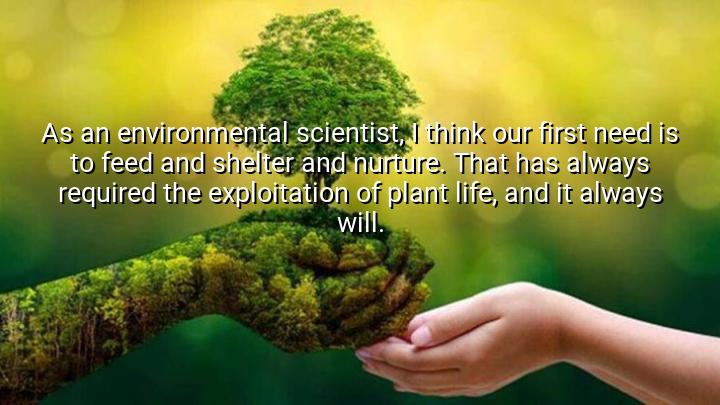




In this quote, Hope Jahren, an environmental scientist, reflects on the fundamental relationship between humanity and the natural world. She emphasizes that our basic needs, such as being able to feed, shelter, and nurture ourselves, have always relied on the exploitation of plant life. By "exploitation," she means the use of plants as resources for food, shelter, and other essential human needs. Jahren is acknowledging that while humans strive to meet their needs, this often requires taking from the environment, particularly from plant life, which has been a constant throughout history.
Jahren’s statement also hints at the sustainability challenge faced by modern society. While she acknowledges the necessity of exploiting plant life, she does not necessarily advocate for the unsustainable or irresponsible exploitation of resources. Her words suggest a recognition of the balance required between meeting human needs and maintaining environmental health. This insight draws attention to the ongoing tension between human survival and environmental conservation—a dynamic central to discussions in environmental science.
By pointing out that the exploitation of plant life "always will" be necessary, Jahren underscores the permanence of humanity's dependence on natural resources. However, her statement also invites reflection on how we use these resources and whether our practices are aligned with principles of sustainability and responsibility. In a time of climate change and environmental degradation, this remark encourages a conversation about how to meet basic human needs without undermining the ecosystems that support life on Earth.
The origin of this quote is rooted in Jahren's career as a scientist who focuses on the intersection of ecology, plant biology, and sustainability. Known for her work on the environmental impacts of human activity, especially in relation to plants, Jahren has long advocated for a deeper understanding of how we interact with the natural world. This quote reflects her broader scientific perspective on the human-environment relationship and how it shapes both our present and future.

AAdministratorAdministrator
Welcome, honored guests. Please leave a comment, we will respond soon