

As a politician who cherishes religious conviction in his personal sphere, but regards politics as a domain belonging outside religion, I believe that this view is seriously flawed.
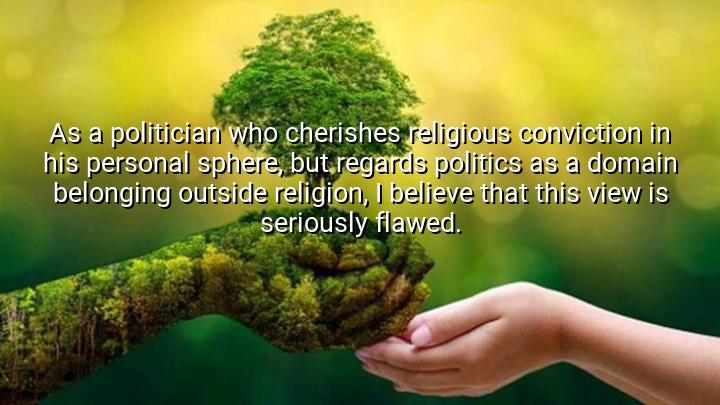




In this quote, Recep Tayyip Erdogan, the President of Turkey, articulates his stance on the relationship between religion and politics. He acknowledges that, as a politician, he values religious conviction in his personal life but argues that politics should not be divorced from religion. Erdogan challenges the idea that political life should remain separate from religious influence, suggesting that this view is flawed. For him, religion plays an important role in shaping a politician’s ethical framework and decision-making process, and its absence from politics undermines the moral foundations of governance.
Erdogan’s perspective reflects his broader political philosophy, where he has often emphasized the importance of Islamic values in shaping Turkish society and governance. He has repeatedly argued that secularism—the principle of separating religion from politics—is not suitable for Turkey’s identity and history. Erdogan’s comment critiques the secular model, which was historically imposed in Turkey after the founding of the Republic under Mustafa Kemal Atatürk. The quote reflects his belief that religion can and should inform the public sphere, guiding moral and ethical decisions in governance.
The origin of this quote is linked to Erdogan's political career, particularly his views on Islam and democracy in Turkey. Throughout his time in office, Erdogan has promoted a vision of Turkey that integrates Islamic values into its political structure, calling for greater representation of religion in the public and political domains. His belief in the unity of religion and politics stands in contrast to secular ideologies that promote the division of these spheres, a stance he believes is necessary for the country’s development and identity.
Erdogan’s statement highlights a key aspect of his political philosophy, which emphasizes the importance of religion in shaping a nation’s moral compass. He believes that religious principles can provide guidance on issues of justice, morality, and social well-being, and that these values should not be excluded from political life. This view is central to his leadership style, as he advocates for a more Islamic-oriented vision of governance, one that blends religious conviction with political decision-making.

AAdministratorAdministrator
Welcome, honored guests. Please leave a comment, we will respond soon