

Artificial intelligence is just a new tool, one that can be used for good and for bad purposes and one that comes with new dangers and downsides as well. We know already that although machine learning has huge potential, data sets with ingrained biases will produce biased results - garbage in, garbage out.
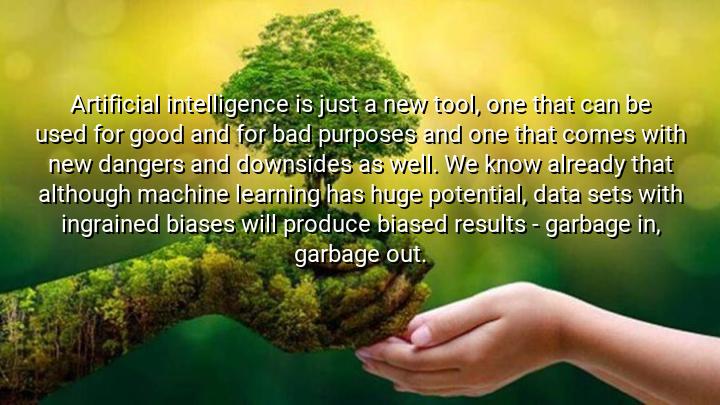




In this quote, Sarah Jeong, a journalist and expert on technology and ethics, reflects on the dual nature of artificial intelligence (AI) and its potential impact on society. She acknowledges that AI is simply a tool, one that can be used for both good and bad purposes. Like any powerful technology, it comes with both benefits and dangers, depending on how it is utilized. Jeong highlights the responsibility that comes with developing and applying AI, noting that it can be shaped to improve lives but also has the potential to create harm if misused.
Jeong also addresses the issue of bias in AI, particularly in the context of machine learning. She points out that data sets used to train AI systems can contain inherent biases, and these biases can directly affect the outcomes produced by the AI. The phrase “garbage in, garbage out” reflects the idea that if flawed or biased data is fed into an AI system, the results will be similarly flawed or biased. This highlights a critical concern in the development of AI: the importance of ensuring that the data used is accurate, diverse, and free from harmful biases.
The quote underscores the ethical challenges that arise when using AI and machine learning. If data reflects historical inequalities or prejudices, the AI systems built on that data will perpetuate those issues. This can result in discriminatory practices, particularly in areas like criminal justice, employment, and healthcare, where AI can impact decisions that affect people's lives. Jeong's statement calls attention to the need for developers to be aware of these biases and actively work to address them in AI design and deployment.
Ultimately, Sarah Jeong’s quote serves as a reminder that while artificial intelligence holds enormous promise, it is not inherently good or bad. The outcomes depend largely on the data it is trained on and the ethical considerations that guide its creation and use. It highlights the need for caution, responsibility, and ongoing vigilance to ensure that AI is used in ways that benefit society and minimize harm.

AAdministratorAdministrator
Welcome, honored guests. Please leave a comment, we will respond soon