

Architecture is the will of an epoch translated into space.
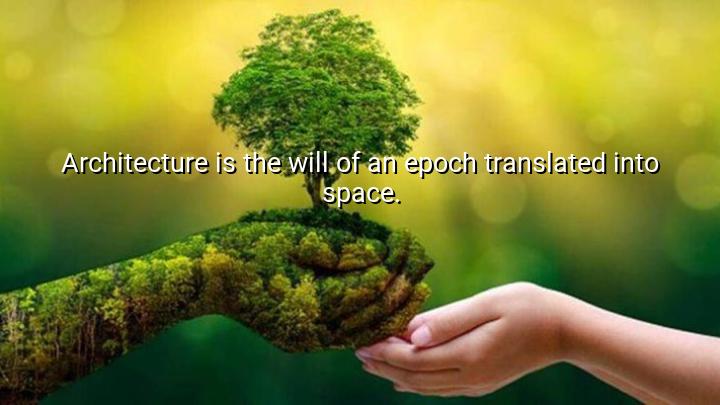




The quote by Ludwig Mies van der Rohe, "Architecture is the will of an epoch translated into space," captures his vision of architecture as a reflection of the spirit of the time. One of the most influential figures of modernist architecture, Mies believed that buildings are not merely physical structures, but expressions of the cultural, technological, and philosophical values of their age. The phrase "will of an epoch" refers to the dominant mindset, priorities, and aesthetic ideals of a particular historical period.
Mies van der Rohe, known for his minimalist philosophy of "less is more," designed buildings that embodied the clarity, functionality, and rationality of the modern era. His work, including the Barcelona Pavilion and the Seagram Building, illustrates how space can be used to convey the ideals of simplicity, openness, and technological progress. By saying that architecture is a translation, he highlights the idea that design is not neutral—it is a physical manifestation of the values and capabilities of its time.
This quote also suggests that each generation has its own unique architectural voice, shaped by advances in materials, shifts in social needs, and changing cultural narratives. For example, the industrial age brought about steel and glass structures, just as digital technology influences contemporary smart buildings. Mies saw architecture as a kind of language that, rather than remaining static, evolves with society.
Ultimately, Mies van der Rohe’s quote is a reminder that architecture is more than shelter—it is a cultural statement. The buildings we construct are not just for use, but also for meaning, echoing the aspirations, challenges, and identity of the era in which they are built. Through this lens, architecture becomes a powerful record of human history, written in space.

KLKhanh Lam
If architecture is indeed the spatial embodiment of an epoch’s will, what happens when different cultural forces within the same time clash? Can a single building or style really speak for a globally interconnected, ideologically diverse world like ours? Maybe architecture today is less about one cohesive narrative and more about a mosaic of competing ideas, which makes me wonder if Mies's idea still fully applies in a postmodern context.
THDoan Thi Thu Hong
Reading this, I’m struck by how poetic the idea is—that space can be a physical expression of an era’s identity. It makes me look differently at even the most mundane city blocks. But does this mean architecture also has a responsibility to guide the future, not just mirror the present? Can architects be visionaries who shape epochs rather than just respond to them?
PNPhuong Nguyen
Mies van der Rohe’s perspective is compelling, but I question whether architecture always succeeds in expressing the zeitgeist. Aren’t some buildings simply aesthetic or functional choices, devoid of deeper commentary? And if architecture translates culture into space, how do we measure its accuracy or relevance over time? Are certain styles misinterpreted or dismissed later because the social context is forgotten?
MNMan Nguyen
This quote makes me think about power and who gets to define the ‘will’ of a time. Is it the government, corporations, the public? If architecture reflects an epoch, does that mean marginalized voices are often left out of the architectural narrative? I’d love to explore how inclusive design can better reflect the diversity of today’s societies and how we avoid repeating the mistakes of more elitist architectural eras.
BPLuong Bich Phuong
I wonder how consciously architects consider the 'will of an epoch' when designing. Is it a deliberate act, or do they just respond intuitively to societal pressures, technology, and available materials? Can we say that modern eco-friendly buildings reflect an age of environmental anxiety and awareness? If so, what does that say about our current epoch—and what legacy are we really leaving behind for future generations?