

Architecture is a code. It's a pure code, derived from the dimensions of nature.
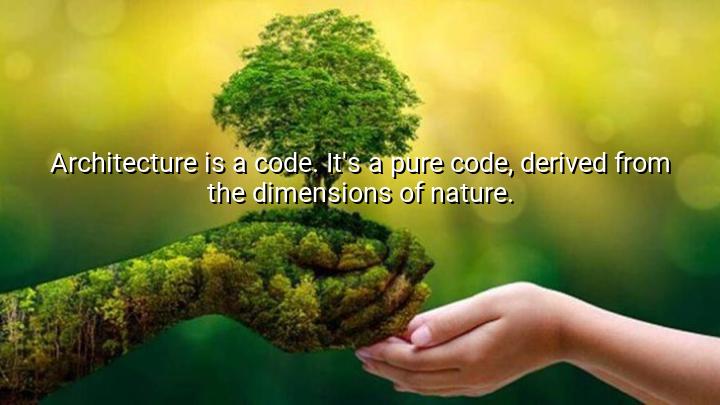




The quote "Architecture is a code. It's a pure code, derived from the dimensions of nature." by Santiago Calatrava reflects his belief in the deep mathematical and structural harmony that underlies both nature and architecture. Calatrava, an architect and engineer known for his sculptural and biomorphic designs, presents architecture not just as an art form, but as a system of rules and relationships—a code—that can be understood, interpreted, and recreated through observation of the natural world.
By calling architecture a "pure code," Calatrava emphasizes the idea that it is built on universal principles, such as proportion, geometry, and balance. These are the same principles that govern natural structures—from the spiral of a seashell to the branching of trees or the symmetry of the human body. For Calatrava, the dimensions of nature offer a blueprint for designing buildings that are both aesthetically pleasing and structurally sound. His work often mimics organic forms, translating natural elegance into architectural expression.
The origin of this concept lies in centuries of architectural theory that explore the connection between nature and design. From Vitruvius in ancient Rome to Leonardo da Vinci’s anatomical studies, architects have long sought to align built forms with natural laws. Calatrava continues this tradition with a modern interpretation, using advanced engineering and digital modeling to create structures that echo living systems while functioning efficiently in the built environment.
Ultimately, Calatrava’s quote underscores his vision of architecture as a fusion of science and art, rooted in the logic of nature. It is not arbitrary or purely stylistic, but a disciplined practice grounded in natural order. Through this lens, architecture becomes more than construction—it becomes a language of forms that speaks in the timeless code of the natural world, inspiring both wonder and understanding.

LPloc pham
Thinking of architecture as a code reminds me of how computer programming or music notation works—there’s logic, structure, and intention. If nature is the source, then should architecture evolve like ecosystems do—responsive, adaptable, and interdependent? I wonder how urban planning fits into this idea. Is the layout of entire cities meant to follow natural systems too, or does the 'code' break down at a certain scale?
VHVu Hoang
I love the elegance of this thought, but I also find it a little abstract. What exactly are the 'dimensions of nature'? Are we talking about proportions, rhythms, structural behaviors, or something more metaphysical? It would be helpful to know how Calatrava defines and applies these dimensions practically—especially since so many of his buildings are both technical marvels and incredibly expressive.
MNLe Minh Nhut
This idea intrigues me, especially in the context of biomimicry in design. If architecture is derived from the dimensions of nature, does that imply modern, abstract buildings that ignore natural proportion or organic inspiration are somehow flawed or incomplete? I wonder how Calatrava reconciles avant-garde or brutalist styles with this perspective. Are they just different codes, or are they outside the 'natural' system?
TANguyen Thao Anh
Calling architecture a 'pure code' is fascinating—it suggests there's a universal language that underpins all successful design. But I’m curious: if this code comes from nature, does it apply equally in every culture and environment? Can human interpretations of this code differ across societies, or is there truly a single underlying formula that great architecture adheres to, no matter the context or intention?
DVTran Dai Vy
This quote makes me wonder how literally Calatrava sees the 'code' of architecture. Is he talking about mathematical precision, like the Fibonacci sequence and golden ratio found in nature? Or is it more of a philosophical stance, where buildings should resonate with the logic and harmony of the natural world? I'd love to understand how this belief influences his structural decisions and aesthetic choices in practice.