

All the lessons of history in four sentences: Whom the gods would destroy, they first make mad with power. The mills of God grind slowly, but they grind exceedingly small. The bee fertilizes the flower it robs. When it is dark enough, you can see the stars.
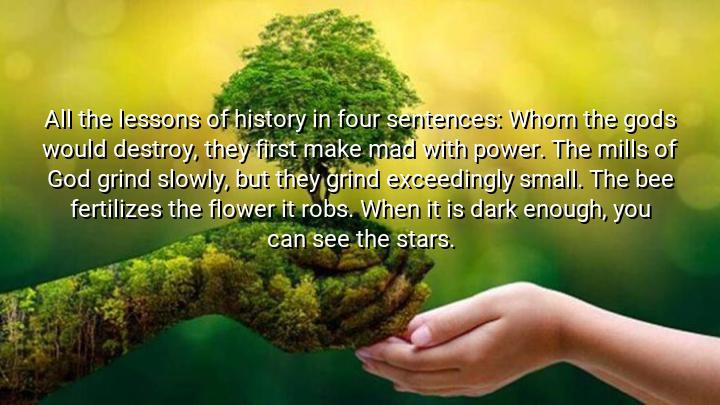




The quote "All the lessons of history in four sentences: Whom the gods would destroy, they first make mad with power. The mills of God grind slowly, but they grind exceedingly small. The bee fertilizes the flower it robs. When it is dark enough, you can see the stars," by Charles A. Beard, encapsulates a deep reflection on human nature, fate, and morality through a series of vivid metaphors. Beard draws on history to convey that power, though often corrupting, can lead to self-destruction, and that justice may be slow but will inevitably prevail. The quote also suggests that even destructive actions can lead to growth and renewal, and that in times of struggle or darkness, new hope and clarity can emerge.
The first sentence, "Whom the gods would destroy, they first make mad with power," references the idea that those who are destined for downfall are often first consumed by the corrupting influence of power, ultimately leading to their own demise. This reflects history's recurring theme of rulers and nations that rise to great power only to fall due to their misuse of it. The second line, "The mills of God grind slowly, but they grind exceedingly small," suggests that while justice may seem delayed, it will eventually be served with precision, no matter how long it takes. This implies that history may take time to correct injustices, but eventually, those responsible for wrongdoing will face consequences.
The third part of the quote, "The bee fertilizes the flower it robs," speaks to the paradox of life, where even destructive actions or exploitation can lead to something positive or necessary, like the pollination process that benefits both the bee and the flower. This metaphor suggests that history and human actions often result in unintended consequences that, while initially harmful, can eventually lead to growth or renewal. Finally, "When it is dark enough, you can see the stars" offers an optimistic conclusion, suggesting that even in times of struggle or despair, clarity and hope emerge. In dark times, the stars—symbolizing hope, guidance, and clarity—become visible, pointing toward a brighter future.
The origin of this quote is tied to Charles A. Beard's focus on historical analysis and his examination of the cyclical nature of power and human actions. Through these four sentences, Beard distills complex lessons from history, illustrating the inevitable consequences of power, the persistence of justice, the paradoxes of life, and the hope that arises even in the most difficult times. The quote serves as both a warning and an inspiration, emphasizing the need to understand the deeper currents of history and human behavior.

AAdministratorAdministrator
Welcome, honored guests. Please leave a comment, we will respond soon