

All the evidence that we have indicates that it is reasonable to assume in practically every human being, and certainly in almost every newborn baby, that there is an active will toward health, an impulse towards growth, or towards the actualization.
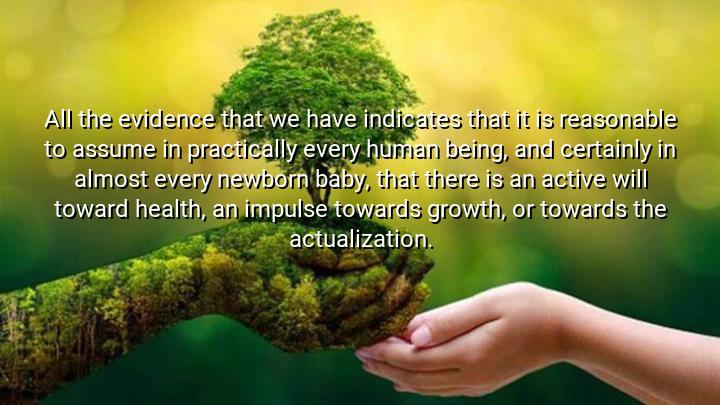




In this quote, Abraham Maslow presents the idea that every human being, particularly in newborn babies, has an inherent will toward health and growth. Maslow suggests that this impulse is a natural part of human existence—an internal drive to achieve well-being, fulfillment, and self-actualization. He argues that this tendency is present in nearly all individuals and forms the foundation of human development and personal growth, starting from birth.
Maslow’s concept of the will toward health is closely tied to his well-known hierarchy of needs, which proposes that humans have a progression of needs, starting with basic survival and moving toward more complex psychological and self-fulfillment needs. According to Maslow, self-actualization, or the realization of one's full potential, is the highest form of human development. This quote highlights the fundamental belief that humans are naturally inclined to seek growth and well-being throughout their lives, striving to reach their fullest potential.
The origin of this quote comes from Abraham Maslow, a psychologist best known for his work on human motivation and self-actualization. His research on human needs and motivation revolutionized psychology, emphasizing the importance of positive human potential rather than focusing solely on pathology or deficiency. Maslow’s theories have been influential in fields like education, therapy, and business, where the focus is on helping individuals grow and reach their potential.
Ultimately, Maslow’s quote reflects his belief in the innate potential of every individual. It underscores the idea that, at our core, humans possess a deep, natural drive toward health, growth, and self-actualization. This drive is essential to human development, shaping not only individual lives but also broader social systems that support the flourishing of individuals.

AAdministratorAdministrator
Welcome, honored guests. Please leave a comment, we will respond soon