

All great deeds and all great thoughts have a ridiculous beginning. Great works are often born on a street corner or in a restaurant's revolving door.
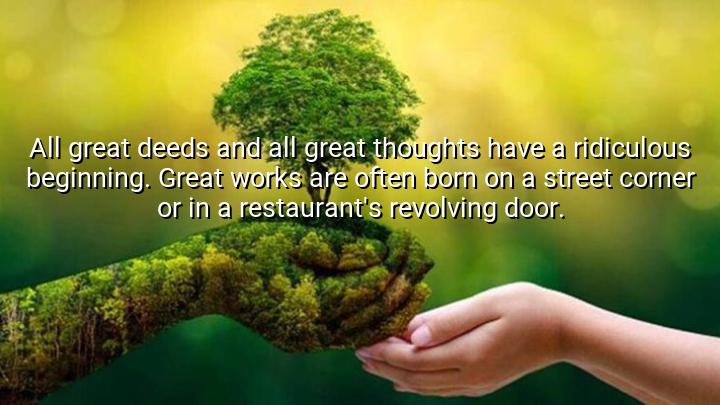




In the quote "All great deeds and all great thoughts have a ridiculous beginning. Great works are often born on a street corner or in a restaurant's revolving door," Albert Camus, the French existentialist philosopher and writer, reflects on the humble and often unexpected origins of greatness. He suggests that great deeds and great thoughts, which later define significant contributions to society, often begin in places or moments that seem trivial or ridiculous at first. Whether sparked by a passing idea, a chance encounter, or an ordinary situation, many of the world's most impactful creations start in unremarkable or serendipitous ways.
Camus emphasizes that greatness does not necessarily arise from carefully planned endeavors but can emerge from the most ordinary or chaotic circumstances. The reference to street corners and a restaurant's revolving door illustrates the idea that moments of inspiration or pivotal actions can happen anywhere, even in the most mundane or unlikely settings. This reinforces the concept that creativity and innovation are not always the product of meticulous strategy but can emerge spontaneously from everyday life.
The quote also speaks to the idea of chance and opportunity in human achievement. By calling attention to the ridiculous beginnings of great works, Camus suggests that the process of achieving greatness is not always linear or predictable. It is shaped by a series of seemingly inconsequential events that, when combined, lead to remarkable outcomes. This perspective encourages a more open-minded approach to life, recognizing that even the smallest actions or ideas can have lasting significance.
Ultimately, Camus’ quote encourages embracing serendipity and being open to the unexpected origins of greatness. It reminds us that significant achievements often start from humble or seemingly absurd beginnings and that the potential for greatness exists in the most ordinary of moments. This perspective challenges the notion that success requires a grand plan or perfect conditions, highlighting the role of chance and openness in shaping the future.

AAdministratorAdministrator
Welcome, honored guests. Please leave a comment, we will respond soon