

After your death you will be what you were before your birth.
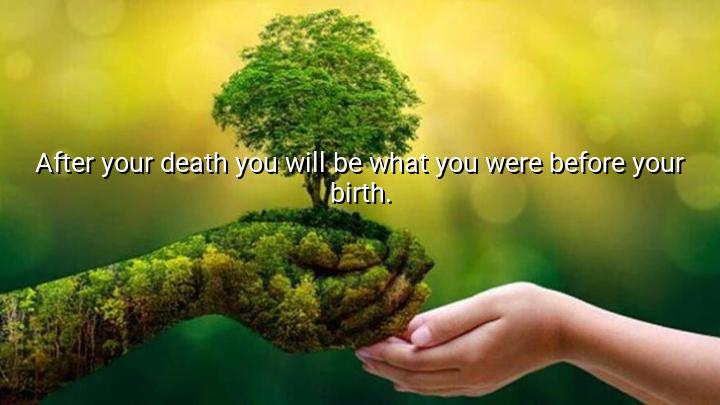




The quote "After your death you will be what you were before your birth" by Arthur Schopenhauer reflects his philosophical view on the nature of existence and death. Schopenhauer suggests that life and death are part of a continuous cycle, where after death, an individual returns to the state of non-being, much like before they were born. This statement emphasizes the transitory nature of human life, suggesting that our time on Earth is but a brief interruption in an otherwise timeless existence. It implies that death, like birth, is merely a return to a state of nothingness.
The origin of this quote can be found within Schopenhauer's pessimistic philosophy, where he often explored the meaning of life, suffering, and the human condition. In his work The World as Will and Representation, Schopenhauer discusses how human beings are driven by an incessant will that ultimately leads to suffering. His views on death are aligned with this broader perspective, where death is not a final end or transition to an afterlife but a return to a pre-existence state of peace or non-awareness. For Schopenhauer, birth and death are both natural processes that contribute to the cycle of life.
In a broader sense, the quote challenges traditional beliefs in afterlife and immortality, urging a more philosophical reflection on the human condition. Schopenhauer, who was influenced by Eastern philosophies like Buddhism and Hinduism, often emphasized the idea of life as suffering and illusion. The statement suggests that our individuality and consciousness are transient, and in death, we return to a state of being that we were in before we took form in this world.
Ultimately, Schopenhauer’s quote invites us to consider the impermanence of life and the futility of human desires and ambitions. By drawing a parallel between birth and death, he points out that our existence is just a brief moment in a larger, timeless context. It encourages a reflection on the nature of self and the limits of human understanding regarding the mysteries of life and death.

AAdministratorAdministrator
Welcome, honored guests. Please leave a comment, we will respond soon