

A man must be willing to die for justice. Death is an inescapable reality and men die daily, but good deeds live forever.
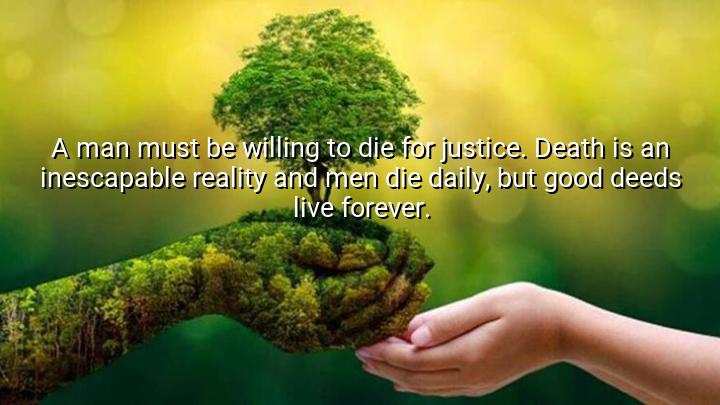




Jesse Jackson's quote emphasizes the importance of commitment to justice and the readiness to make the ultimate sacrifice for it. By stating that "a man must be willing to die for justice," Jackson suggests that standing up for what is right often requires a profound sense of dedication and, at times, personal risk. In this context, justice is portrayed as a cause worth fighting for, even at the cost of one’s life. This sentiment is rooted in the understanding that significant change and progress often demand courage in the face of adversity.
The second part of the quote, "Death is an inescapable reality and men die daily," reflects the inevitability of death itself, acknowledging that it is a part of the human experience. Jackson uses this reality to underscore the point that, while death is certain, the impact of one’s good deeds can transcend mortality. The reference to men dying daily suggests that death is common, but the legacy of one's actions—especially those driven by justice—can have a lasting, eternal influence.
Jackson further implies that while physical death is inevitable, the actions taken in the name of justice and goodness can live on far beyond a person's lifetime. Good deeds are immortal in the sense that they continue to inspire and affect others long after the person is gone. This idea ties into a larger philosophical notion that while our lives may be finite, our contributions to society can have a timeless effect.
Ultimately, the quote conveys a powerful message about the importance of selflessness and the enduring value of fighting for what is right, regardless of the consequences. Jesse Jackson’s words encourage us to remember that while death may be unavoidable, the pursuit of justice can leave a legacy that outlasts any individual's lifetime.

AAdministratorAdministrator
Welcome, honored guests. Please leave a comment, we will respond soon