

A lot of people in our industry haven't had very diverse experiences. So they don't have enough dots to connect, and they end up with very linear solutions without a broad perspective on the problem. The broader one's understanding of the human experience, the better design we will have.
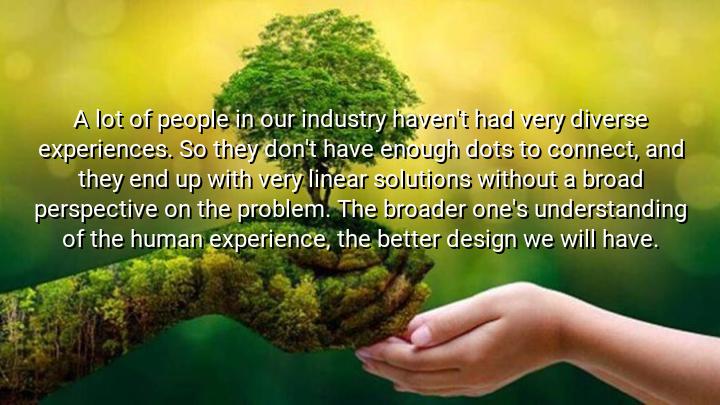




The quote by Steve Jobs—“A lot of people in our industry haven't had very diverse experiences. So they don't have enough dots to connect, and they end up with very linear solutions without a broad perspective on the problem. The broader one's understanding of the human experience, the better design we will have”—emphasizes the vital connection between life experience and innovation. Jobs is pointing out that limited backgrounds often lead to narrow thinking, whereas creativity thrives on a rich mix of influences and insights.
Jobs, co-founder of Apple, was known not only for his technological vision but also for his deep appreciation of art, culture, and human behavior. His reference to “dots to connect” is a nod to his own journey, famously illustrated in his 2005 Stanford commencement speech, where he described how a seemingly irrelevant calligraphy class later influenced the typographic beauty of the Macintosh. For Jobs, true design excellence doesn’t come from technical skills alone—it stems from understanding the complexity and diversity of life.
By criticizing “linear solutions,” Jobs suggests that many in the tech world solve problems in predictable, step-by-step ways that lack depth or empathy. He argues that to develop truly impactful and user-centered designs, creators must broaden their view to include the emotional, cultural, and social dimensions of the people they are designing for. This requires curiosity, openness, and a willingness to engage with diverse experiences beyond one’s comfort zone.
Ultimately, this quote is a call for interdisciplinary thinking and human-centered design. Jobs believed that the best products are born at the intersection of technology and the humanities, and that only by understanding the full scope of human experience can designers and innovators build solutions that are both elegant and meaningful. It’s a philosophy that continues to influence the fields of design, business, and technology worldwide.

AAdministratorAdministrator
Welcome, honored guests. Please leave a comment, we will respond soon