

Your body is the church where Nature asks to be reverenced.
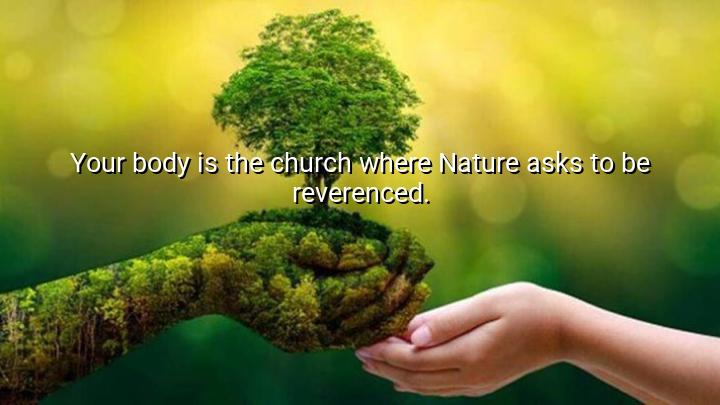




In this quote, Marquis de Sade, a controversial French philosopher and writer, presents a provocative yet deeply symbolic idea about the human body and its relationship to Nature. When he says, "Your body is the church where Nature asks to be reverenced," he is suggesting that the human form is sacred—not in a religious or institutional sense, but as a natural creation worthy of honor and respect. By comparing the body to a church, a traditionally holy place, de Sade elevates the body as a site of reverence, experience, and connection to the natural world.
This quote reflects de Sade’s broader philosophical stance, which often challenged conventional morality, religion, and societal norms. He saw Nature as a powerful, guiding force and frequently explored how human desires and instincts were natural rather than sinful. In this context, the body is not something to be shamed or suppressed, but rather celebrated as a vessel through which Nature expresses itself. It’s a call to embrace physical existence as meaningful and spiritual in its own right.
The idea of reverence in this quote implies that we should treat our bodies with the same care, attention, and awe that we might show in a sacred place. It encourages readers to reflect on how they treat their own bodies—not just physically, but emotionally and philosophically. For de Sade, rejecting guilt and embracing the physical self was central to achieving a more liberated existence.
The origin of this quote lies within de Sade’s broader body of work, which spans fiction, essays, and philosophical texts from the late 18th century. While his writings are often remembered for their explicit content, they also contain complex critiques of religious dogma, social hypocrisy, and moral rigidity. This particular quote encapsulates one of his less shocking but deeply thought-provoking insights, urging us to see the body not as a burden or a source of shame, but as a sacred embodiment of Nature itself.

AAdministratorAdministrator
Welcome, honored guests. Please leave a comment, we will respond soon