

You would be amazed what the ordinary guy knows.
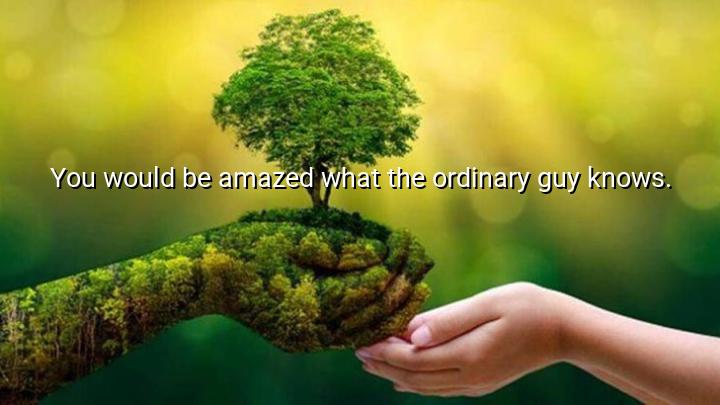




The quote by Matt Drudge — "You would be amazed what the ordinary guy knows." — speaks to the idea that even individuals who may not have formal education or fame possess a wealth of knowledge and insight. Drudge suggests that everyday people, often dismissed or overlooked, can have a deep understanding of the world around them. The use of "amazed" emphasizes the surprising or underestimated depth of knowledge that ordinary individuals can hold, challenging the notion that expertise or valuable information is limited to the highly educated or famous.
Drudge's statement is a reminder that wisdom and insight can come from a variety of sources, not just those in positions of power or authority. It suggests that ordinary people often have practical knowledge, experience, and common sense that may be just as valuable as academic or professional expertise. This challenges societal assumptions that only certain groups have access to important ideas or solutions.
The origin of this quote comes from Drudge's experience as a journalist and the founder of the Drudge Report, a news aggregation website. Known for breaking stories that were often ignored by mainstream media, Drudge recognized the power of alternative sources of information and the importance of being open to voices outside of traditional authority. His quote reflects his appreciation for the untapped knowledge found in everyday people, particularly in the age of information and social media, where anyone can contribute and influence.
Ultimately, Drudge's words emphasize the value of common knowledge and the idea that wisdom can be found in unexpected places. By acknowledging the insights of the ordinary guy, he encourages us to recognize the importance of diverse perspectives and the potential of every individual to contribute to broader conversations and solutions.

QT12 Nguyen Quoc Thong
Interesting how this flips the script on what we define as ‘valuable knowledge.’ Does this mean that expertise is overrated, or that different forms of knowledge can coexist? I’m curious about how this perspective applies in journalism or politics—fields where gatekeeping is so strong. Could the ‘ordinary guy’ be the most trustworthy source in some cases? What does this say about where we place authority?
PPhamphatdat
I find this quote both empowering and a little sad. Empowering, because it honors people whose voices are rarely heard. Sad, because it means we often walk past deep knowledge without even realizing it. Is it because we’ve become so conditioned to look for wisdom only in certain places—universities, books, media? How can we become better at recognizing the intelligence in everyday conversations?
TTNguyen Thanh Tung
This makes me wonder about how often ‘ordinary’ people are overlooked in conversations about big issues—like climate change, economics, or healthcare. Shouldn't we be tapping into grassroots knowledge more often? Maybe the best solutions come from people closest to the problem. What if society prioritized listening to these voices before making policies that affect them directly?
TP33 NGUYEN HOANG TAN PHAT
It's kind of humbling when you think about it. There’s a quiet wisdom in lived experience that can’t be found in textbooks. What do we lose when we dismiss someone just because they don't have a big platform or a fancy title? I think about my grandparents, for example—their knowledge was earned, not learned. Do you think we’ll ever shift our culture to honor this kind of wisdom more broadly?
LNLam Nguyen
I really connect with this thought. It reminds me of how people in everyday jobs—cashiers, drivers, janitors—often have profound insights about life, society, or even politics. Is our culture too focused on experts and celebrities to truly value the knowledge of everyday individuals? I’d love to hear others’ stories of ‘ordinary’ people who’ve said something unexpectedly wise or eye-opening. We need to listen more intentionally.