

You take a number of small steps which you believe are right, thinking maybe tomorrow somebody will treat this as a dangerous provocation. And then you wait. If there is no reaction, you take another step: courage is only an accumulation of small steps.
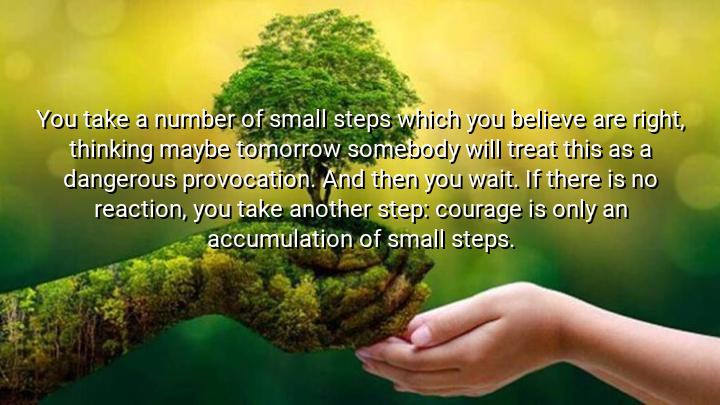




In this quote, George Konrad emphasizes the idea that courage is not always about dramatic, singular acts of heroism, but rather the accumulation of small steps taken over time. He suggests that courage is often built through a series of incremental actions, where each step is based on one’s beliefs and values, even if the results or reactions are uncertain. The notion of waiting for a reaction highlights the patient, often quiet nature of true courage.
Konrad’s words also convey the idea that courage doesn’t always manifest in bold or immediate actions. Instead, it can emerge through a steady commitment to doing what one believes is right, even in the face of potential backlash. The fear of being viewed as a provocation or disrupting the status quo might hold people back, but the willingness to take those small steps—regardless of the outcome—is what defines true courage.
The concept of waiting for a reaction speaks to the inner strength required to stay resolute in one’s convictions without immediate validation or external support. It acknowledges that courage often requires patience, as the impact of each step may not be felt immediately, and the individual may not know if others will recognize or understand the significance of their actions.
Ultimately, Konrad’s quote reminds us that courage is not always a bold, heroic moment but a collection of deliberate, small actions based on principles and integrity. It is about the ongoing commitment to move forward, despite the uncertainty of how others will perceive or respond to those actions. Courage, therefore, becomes a habit of consistently making the right choices, regardless of immediate consequences.

AAdministratorAdministrator
Welcome, honored guests. Please leave a comment, we will respond soon