

You practice mindfulness, on the one hand, to be calm and peaceful. On the other hand, as you practice mindfulness and live a life of peace, you inspire hope for a future of peace.
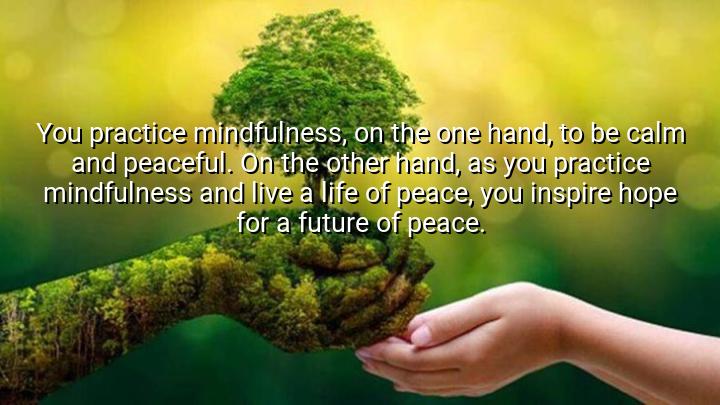




In this quote, Thich Nhat Hanh, a renowned Vietnamese Buddhist monk and peace activist, emphasizes the dual role of mindfulness in achieving both personal peace and contributing to a greater societal peace. He explains that practicing mindfulness allows an individual to cultivate calm and peacefulness within themselves, helping to reduce stress and increase overall well-being. The practice involves being fully present in the moment, aware of thoughts and emotions, without judgment, which leads to a more peaceful state of mind.
At the same time, Thich Nhat Hanh notes that this personal peace can ripple outward. As individuals adopt a life of peace through mindfulness, they naturally inspire others, creating a collective energy of hope for a future built on peace. By embodying peace in daily life, a person can influence those around them, fostering a more harmonious environment and encouraging others to adopt peaceful ways of thinking and living.
The quote also touches on the interconnectedness of personal and global peace, suggesting that lasting peace in the world begins with individuals. When people practice mindfulness, they not only improve their own lives but also contribute to the broader societal change. The practice of mindfulness, then, becomes both an internal process of self-care and an external act of social contribution.
Ultimately, Thich Nhat Hanh's message highlights that peace is not just a personal pursuit but a communal one. Through mindful living, individuals can inspire a ripple effect, spreading hope and the possibility of a more peaceful world. His words remind us that our actions, grounded in mindfulness, have the power to shape the future for the better.

AAdministratorAdministrator
Welcome, honored guests. Please leave a comment, we will respond soon