

You entertain people who are satisfied. Hungry people can't be entertained - or people who are afraid. You can't entertain a man who has no food.
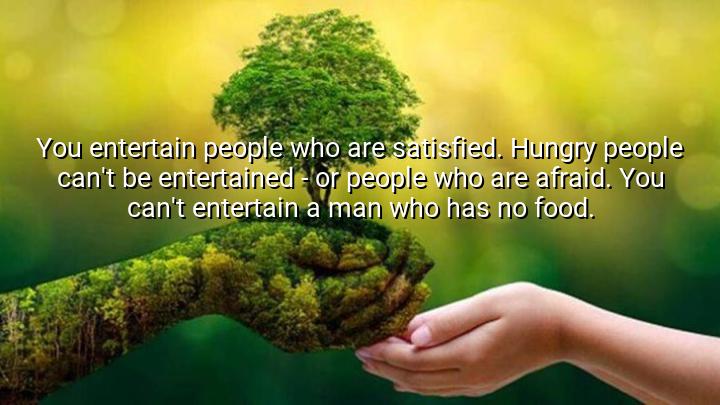




This quote by Bob Marley, the legendary Jamaican musician and cultural icon, underscores the connection between basic human needs and the role of entertainment in society. When he says, “Hungry people can't be entertained,” Marley is pointing out that entertainment, music, and art—while powerful—are not sufficient when people are struggling with survival. A person who lacks food or lives in fear cannot truly enjoy or engage with creative expression, because their most immediate concerns are unmet.
Marley’s quote highlights a deeper message about social justice and human dignity. The statement “You can't entertain a man who has no food” reflects his awareness of the inequalities that exist in the world, particularly in developing countries and among oppressed communities. He believed that before people could appreciate joy, celebration, or art, they needed security, freedom, and nourishment. This perspective shaped much of his music, which blended uplifting rhythms with profound messages about poverty, oppression, and resistance.
The origin of this quote comes from interviews and conversations where Marley spoke not just as an artist, but as a messenger of consciousness. Deeply influenced by his Rastafarian faith and political awareness, he used his global platform to advocate for the poor, the dispossessed, and the voiceless. Songs like Them Belly Full (But We Hungry) echo this very theme—reminding listeners that material inequality often silences joy and limits cultural participation.
Ultimately, Marley’s quote serves as a powerful reminder that art cannot substitute for justice. While entertainment may uplift the spirit, true engagement with it depends on meeting the fundamental needs of life. His words call on society to address hunger, fear, and inequality, so that everyone has the chance to not only survive, but to enjoy the beauty and freedom that music and culture can bring.

AAdministratorAdministrator
Welcome, honored guests. Please leave a comment, we will respond soon