

You ask me if I keep a notebook to record my great ideas. I've only ever had one.
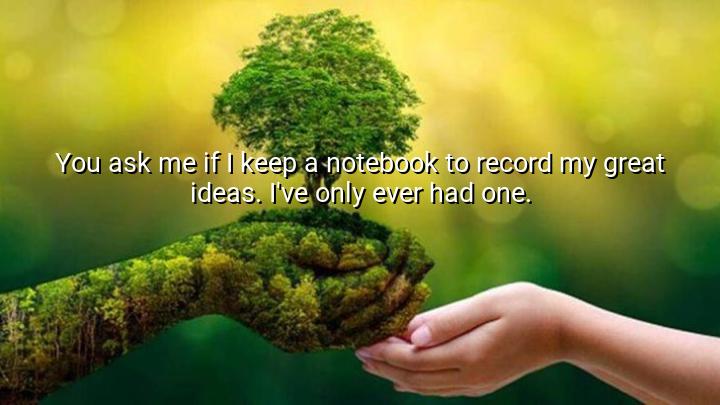




Albert Einstein’s quote, “You ask me if I keep a notebook to record my great ideas. I’ve only ever had one,” reflects his belief in the simplicity and effortlessness of creativity. By saying that he has only ever had one idea, Einstein is suggesting that true inspiration and insight don’t necessarily come from constant recording or detailed planning. Instead, great ideas are often the result of a singular, powerful realization or thought that transcends the need for extensive note-taking or preparation.
The quote also highlights Einstein’s view that creativity and genius are not always the product of constant, systematic effort. While many people may keep notebooks full of ideas, the implication is that truly revolutionary thoughts may arise spontaneously or in moments of clarity, rather than being carefully curated over time. This statement emphasizes the natural nature of his intellectual process, suggesting that the most profound ideas might emerge without the need for exhaustive recording or documentation.
By referring to just one great idea, Einstein also subtly downplays the pressure to constantly generate new concepts or to constantly be innovative. In his view, a single remarkable idea can have a far-reaching impact, rather than having to rely on a continual flow of ideas. The focus, therefore, is on quality over quantity—having one truly insightful idea is more valuable than having many less significant ones.
The origin of the quote comes from Albert Einstein, the renowned physicist whose contributions to science, particularly the theory of relativity, revolutionized our understanding of the universe. Known for his deep thought and occasional unorthodox approach to problem-solving, Einstein often emphasized the importance of intuition, imagination, and simplicity in both scientific and intellectual pursuits. This quote aligns with his broader philosophy that true innovation often emerges from a singular vision rather than continuous, methodical work.

AAdministratorAdministrator
Welcome, honored guests. Please leave a comment, we will respond soon