

You are free; you are free to go to your temples, you are free to go to your mosques or to any other place or worship in this State of Pakistan. You may belong to any religion or caste or creed - that has nothing to do with the business of the State.
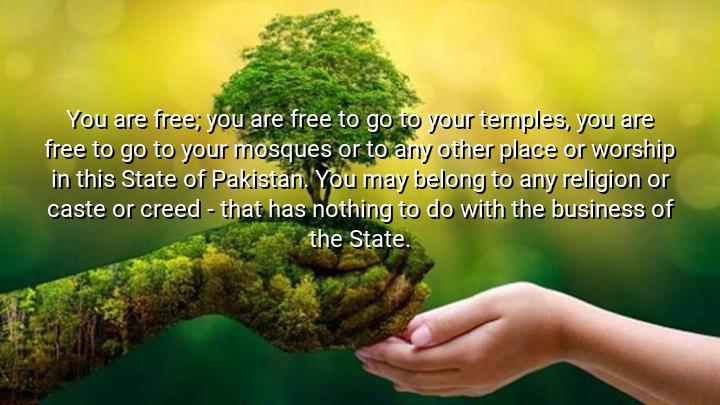




The quote by Muhammad Ali Jinnah, "You are free; you are free to go to your temples, you are free to go to your mosques or to any other place of worship in this State of Pakistan. You may belong to any religion or caste or creed—that has nothing to do with the business of the State," underscores the principle of religious freedom and secular governance. Jinnah emphasizes that individuals in Pakistan have the right to practice their religion freely, and that the government should remain neutral and not interfere in matters of faith or personal belief. This statement promotes tolerance and the separation of religion from state affairs.
The origin of this quote dates back to Jinnah’s role as the founding father of Pakistan and the leader of the movement for its independence. His vision for Pakistan was that of a pluralistic society where all religious and ethnic communities could coexist peacefully with equal rights and freedoms. This quote reflects his commitment to establishing a state that respects diversity and upholds individual liberties regardless of religious affiliation.
On a deeper level, the quote highlights the foundational values of inclusivity and human rights in the early constitutional principles of Pakistan. Jinnah’s assurance aimed to unite various communities under a shared national identity while ensuring that the state would not become a tool for religious discrimination or sectarianism. It encourages respect for all faiths and fosters a culture of mutual coexistence.
Ultimately, Muhammad Ali Jinnah’s words serve as a powerful affirmation of freedom of religion and the importance of maintaining a secular government that protects the rights of all citizens. His vision continues to resonate as a guiding ideal for pluralism and harmony in Pakistan’s diverse society.

AAdministratorAdministrator
Welcome, honored guests. Please leave a comment, we will respond soon