

Yes, love indeed is light from heaven; A spark of that immortal fire with angels shared, by Allah given to lift from earth our low desire.
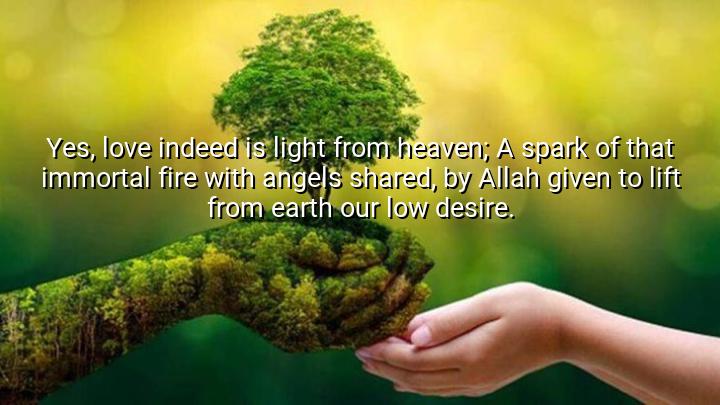




In this quote, Lord Byron elevates the concept of love, describing it as a divine light that originates from heaven. He presents love as a powerful and pure force, a spark of an immortal fire shared by angels and bestowed upon humanity by Allah. The imagery of light from heaven symbolizes the sacred and transcendent nature of love, suggesting that it has the capacity to lift human beings beyond their earthly desires and material concerns. Love, in Byron's view, is not just a fleeting emotion, but a divine gift that connects humans to the higher realms and encourages spiritual elevation.
Byron's use of the phrase "immortal fire" reinforces the idea that love is eternal, not bound by time or mortality. It is a force that exists beyond earthly limitations, capable of transcending the mundane and touching the divine. The fire metaphor also implies that love is intense, passionate, and consuming. It burns away the lower desires of the human condition, urging people to reach for something greater and more profound. The reference to angels and Allah suggests that love is a gift not just for human beings, but a force shared with the heavenly realm, giving it a sacred and universal quality.
This quote also reflects Byron's romantic ideals, where love is often portrayed as the highest form of human experience, one that transcends the ordinary and aligns individuals with the divine. His use of love in such a grand, cosmic context speaks to the emotional depth and spiritual significance he attributed to it. Byron, as a leading figure of the Romantic movement, frequently explored themes of passion, beauty, and the divine in his poetry, and this quote is a prime example of his tendency to connect human emotions with the larger cosmic order.
The origin of the quote is from Lord Byron, one of the most prominent poets of the Romantic era. Known for his works like Don Juan and Childe Harold's Pilgrimage, Byron’s poetry often dealt with themes of love, freedom, and the struggle between individuality and societal expectations. His exploration of love as a divine and transformative force reflects both the spiritual and emotional aspects of the Romantic period, which valued intense personal experiences and a deep connection to nature, the divine, and human emotions.

AAdministratorAdministrator
Welcome, honored guests. Please leave a comment, we will respond soon