

Words are only painted fire; a look is the fire itself.
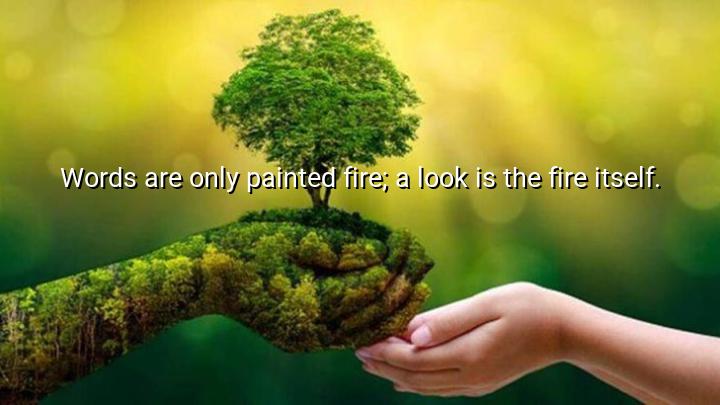




The quote “Words are only painted fire; a look is the fire itself.” by Mark Twain explores the contrast between language and nonverbal expression, particularly the raw power of a glance or facial expression. Twain suggests that while words can describe or imitate emotion, they are merely a representation—like a painting of fire rather than fire itself. In contrast, a look can convey genuine feeling, intensity, and truth in a way that language often cannot.
Mark Twain, one of America’s most iconic writers and humorists, was known for his sharp observations on human nature, communication, and society. This quote likely comes from his reflections on how people express themselves and connect beyond mere spoken or written words. Twain recognized the limits of verbal expression and acknowledged the undeniable power of presence, gesture, and especially eye contact to communicate what words might fail to capture.
By describing words as “painted fire,” Twain emphasizes their artificiality or indirectness. While language can evoke emotion, it remains a step removed from the real experience. A look, on the other hand, is immediate, visceral, and impossible to fake—it is the “fire itself,” the unfiltered emotion that transcends the boundaries of speech. In many ways, this quote celebrates the power of human connection through silent understanding.
Ultimately, Twain’s words remind us that communication is more than just verbal fluency. True emotion, intention, and depth often reside in the unspoken—in the expressions we share, the glances we exchange, and the energy we give off. It’s a poetic nod to the richness of nonverbal language, suggesting that sometimes, the most powerful message is the one never spoken aloud.

AAdministratorAdministrator
Welcome, honored guests. Please leave a comment, we will respond soon