

Women are the victims of this patriarchal culture, but they are also its carriers. Let us keep in mind that every oppressive man was raised in the confines of his mother's home.
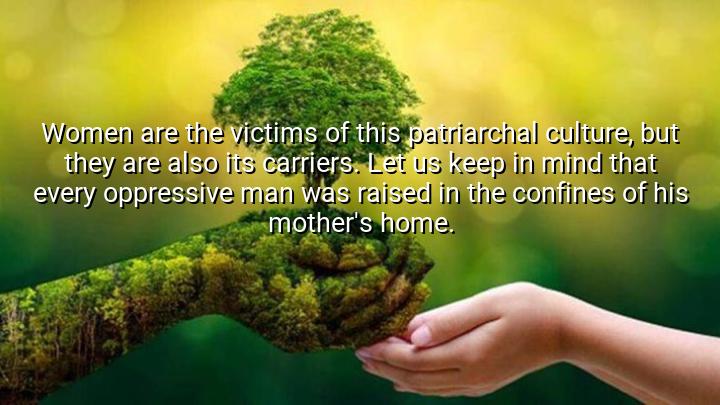




The quote "Women are the victims of this patriarchal culture, but they are also its carriers. Let us keep in mind that every oppressive man was raised in the confines of his mother's home" by Shirin Ebadi highlights the complex and often contradictory roles women play in patriarchal societies. Ebadi, an Iranian human rights lawyer and Nobel Peace Prize laureate, is known for her advocacy for women's rights and her critique of social structures that perpetuate gender inequality. In this quote, she suggests that while women are often oppressed by patriarchal systems, they also play a role in perpetuating these systems, particularly through their roles as mothers.
The first part of the quote, where women are described as victims, acknowledges the historical and ongoing oppression of women in societies where patriarchy dominates. However, Ebadi complicates this view by stating that women are also the carriers of this patriarchal culture. This suggests that women, often through socialization and their roles in raising children, may unknowingly or unwillingly contribute to maintaining patriarchal norms and values. They may pass down the gendered expectations and roles that are deeply ingrained in society, even if they themselves are victims of these systems.
Ebadi then focuses on the role of mothers in shaping the future generations of men. By stating, "every oppressive man was raised in the confines of his mother's home," she underscores the idea that the behaviors and attitudes of men, including those that uphold patriarchal and oppressive systems, are learned early in life, often through their mothers. This highlights the profound influence that women have on the development of social norms and values, even when they are themselves subjected to oppressive structures.
Ultimately, Ebadi’s quote calls for a recognition of the cyclical nature of oppression. While women may suffer under patriarchy, they also hold significant power in shaping the next generation, for better or for worse. It urges reflection on how societal change requires not only addressing the structures that perpetuate patriarchy but also rethinking how individuals are socialized and how women, despite being oppressed, may unknowingly contribute to the maintenance of these systems.

AAdministratorAdministrator
Welcome, honored guests. Please leave a comment, we will respond soon