

Where is the Life we have lost in living? Where is the wisdom we have lost in knowledge? Where is the knowledge we have lost in information?
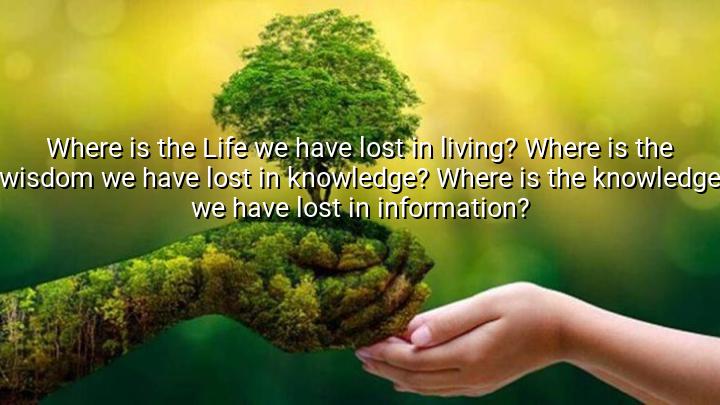




The quote "Where is the Life we have lost in living? Where is the wisdom we have lost in knowledge? Where is the knowledge we have lost in information?" by T. S. Eliot reflects on the disconnection between superficial accumulation and meaningful understanding. Eliot, a British-American poet, essayist, and literary critic, explores the idea that modern life often prioritizes busyness, data, and facts over deeper experience, insight, and understanding. The quote questions whether in the pursuit of knowledge and information, we have lost the essence of living, the application of wisdom, and the true value of learning.
The origin of this quote comes from Eliot’s poem “Choruses from ‘The Rock’” (1934), where he critiques the fragmentation and mechanization of modern society. He observed that people often collect information and knowledge without integrating it into meaningful action or reflective living, resulting in a life that is technically informed but spiritually and emotionally impoverished. Eliot uses a series of rhetorical questions to provoke reflection on the priorities and consequences of contemporary existence.
The deeper meaning of the quote highlights the importance of balance and integration. Life should not be reduced to mere survival, acquisition of knowledge, or processing of information; rather, it should encompass experience, wisdom, and understanding. Eliot challenges readers to consider whether they are truly living and learning, or simply accumulating data and tasks without purpose or reflection.
In modern contexts, this quote resonates in education, technology, leadership, and personal development, where the overload of information and data can overshadow meaningful experience and applied wisdom. Eliot’s insight encourages mindfulness and intentionality, reminding us that true knowledge and living require reflection, application, and a connection to the deeper purposes of life, rather than mere accumulation or mechanical engagement.

AAdministratorAdministrator
Welcome, honored guests. Please leave a comment, we will respond soon