

When you think of intelligence, don't think of a college professor; think of human beings as opposed to chimpanzees. If you don't have human intelligence, you're not even in the game.
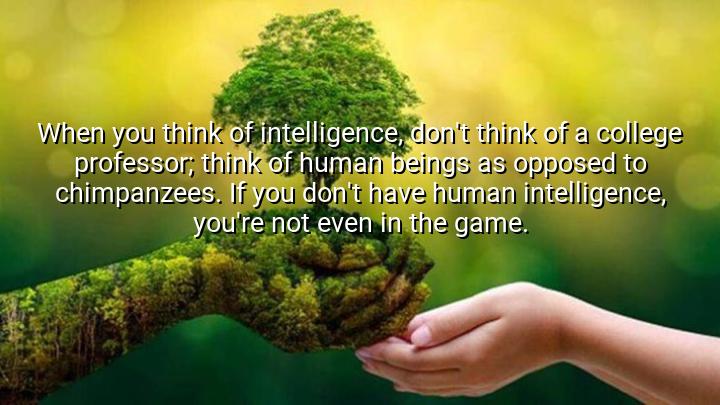




Eliezer Yudkowsky's quote challenges conventional ideas about intelligence and reframes how we understand it. By saying, "When you think of intelligence, don't think of a college professor; think of human beings as opposed to chimpanzees," Yudkowsky emphasizes that human intelligence is not merely about academic knowledge or intellectual achievements, but rather about the unique cognitive capabilities that distinguish humans from other species. This includes advanced problem-solving, communication, and abstract thinking that are central to the human experience.
The reference to chimpanzees serves as a comparison to show that intelligence is not a one-dimensional concept tied only to formal education or intellectualism. Rather, it’s about the inherent human ability to reason, adapt, and innovate in ways that other animals cannot. By using chimpanzees as a benchmark, Yudkowsky highlights the evolutionary leap that defines human cognition, setting us apart from our closest animal relatives in terms of mental capabilities.
The second part of the quote, "If you don't have human intelligence, you're not even in the game," underscores the importance of having the fundamental cognitive abilities that are part of being human. Yudkowsky suggests that lacking these core aspects of human intelligence means that one would be unable to fully engage in the complexities of human society, whether in communication, problem-solving, or social interaction. It’s a way of saying that basic intelligence is the minimum requirement to function effectively in the world.
In a broader sense, this quote challenges us to think beyond traditional definitions of intelligence and recognize that true intelligence is about adaptability, innovation, and social interaction, all of which are uniquely human traits. Yudkowsky's words invite us to appreciate intelligence as a dynamic, multifaceted quality that goes beyond academic prowess, emphasizing the practical and evolutionary aspects of human thought.

AAdministratorAdministrator
Welcome, honored guests. Please leave a comment, we will respond soon