

When you start learning how to give when you're young, when you get older it is second nature. Just like stealing. Start young and you keep on stealing forever. Ask my politicians.
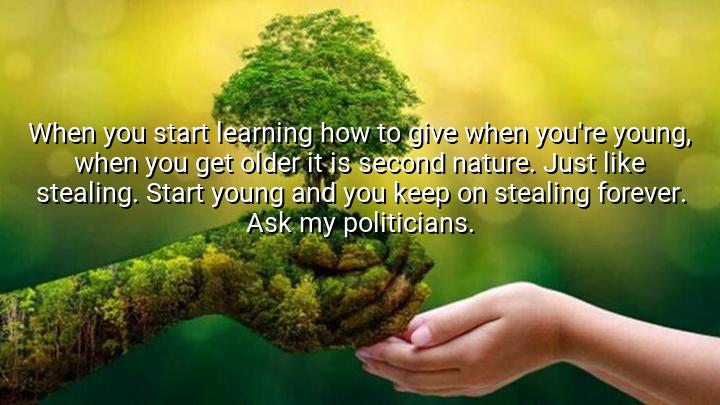




The quote by Mechai Viravaidya, "When you start learning how to give when you're young, when you get older it is second nature. Just like stealing. Start young and you keep on stealing forever. Ask my politicians," emphasizes the importance of early moral education and how habits formed in youth often shape behavior in adulthood. Viravaidya contrasts positive actions, such as giving, with negative behaviors, like stealing, highlighting that both generosity and corruption can become ingrained if cultivated early. The quote underscores the role of upbringing and early experience in forming lifelong values and character.
By using the example of politicians, Viravaidya offers a sharp social critique, suggesting that patterns of dishonesty or corruption are often established and normalized over time. The comparison between giving and stealing stresses that ethical behavior is learned and practiced repeatedly; good habits can become natural, while harmful habits can perpetuate systemic problems. It serves as both a personal lesson and a broader commentary on societal behavior.
The origin of this quote comes from Mechai Viravaidya’s extensive work as a social activist and politician in Thailand, particularly in promoting public health, family planning, and community development. Known for his innovative and sometimes humorous approach to social reform, Viravaidya often used vivid metaphors to communicate moral and practical lessons. His focus on education, both formal and informal, reflects his belief that long-term social change begins with instilling values early in life.
Ultimately, Viravaidya’s quote is both a guideline and a warning. It emphasizes the power of early influence on lifelong behavior, encouraging societies and families to nurture habits of generosity, honesty, and ethical responsibility from a young age. Simultaneously, it critiques systems where negative behaviors, like corruption, become entrenched, reminding us that moral education is crucial for building a fair and just society.

AAdministratorAdministrator
Welcome, honored guests. Please leave a comment, we will respond soon