

When you love somebody, or something, it's amazing how willing you are to overlook the flaws.
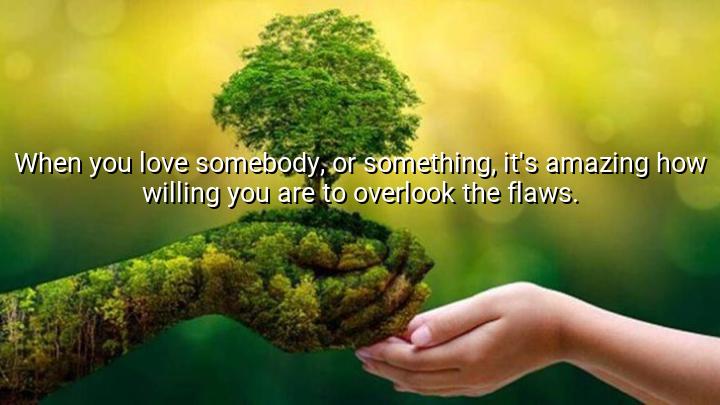




This quote by Caroline Knapp, an American author and journalist, explores the emotional depth and complexity of love. When she says, “it’s amazing how willing you are to overlook the flaws,” she highlights a powerful truth: love often brings with it a kind of selective vision, where imperfections fade in the presence of deep affection. Whether directed toward a person, a passion, or even a habit, love has the ability to soften judgment and amplify connection.
Knapp’s insight reflects her broader themes as a writer, particularly in her memoirs like Drinking: A Love Story, where she examines personal struggles, addiction, and emotional attachment with raw honesty. This quote can be interpreted in both romantic and psychological terms—how emotional bonds can lead people to accept behaviors or situations they might otherwise question. It speaks to the human tendency to prioritize connection over perfection.
The origin of this quote comes from Knapp’s reflective and introspective body of work, where she often delved into topics like identity, dependency, and the emotional contradictions that define our inner lives. Her writing was known for its vulnerability and clarity, offering readers profound observations on the emotional compromises we make in love and life.
Ultimately, Knapp’s quote reminds us that love is not always logical. It allows us to see beyond faults, to forgive, and to accept in ways we might not expect. This capacity to overlook flaws isn’t weakness—it’s a reflection of the powerful, often amazing, emotional commitment that love inspires.

QCTRAN QUYNH CHI
This quote feels very relatable, especially in long-term relationships. Over time, we naturally start noticing flaws, but love makes those flaws feel less important. However, it also raises a question: does love evolve into something more balanced over time, where we no longer 'overlook' flaws but instead genuinely accept them? Is that what maturity in love looks like?
PHNgoc My Phan Huynh
What Caroline Knapp said feels deeply human. We all want to believe that love is strong enough to see past the negatives. But I’m curious—do you think this perspective contributes to people staying in relationships or situations longer than they should? Is love meant to be blind, or is true love actually about seeing everything clearly and choosing to stay anyway?
AAn
I find this quote both beautiful and a little bit unsettling. It’s comforting to know that love can make us accepting, but it’s also a bit scary how easy it is to overlook red flags. How can we stay emotionally open while also protecting ourselves from being taken advantage of? Is unconditional love truly healthy if it comes at the expense of our boundaries?
Hhuahainam
Such a simple statement, yet it holds a lot of truth. I think it applies to more than just romantic love too—family, pets, even hobbies. We tolerate so much more from what we love. But I wonder, does this kind of tolerance sometimes blind us from personal growth or better choices? Is there a point where love turns into justification for discomfort or denial?
MBQuynh Mai Bui
I resonate with this so much—when you’re deeply connected to someone, it’s like the imperfections fade into the background. But is that always a good thing? I wonder how many people stay in toxic situations because love makes them rationalize things they shouldn’t. How do we stay honest with ourselves while still embracing the humanity in the people we care about?