

When we project the specific organization of the human body into the space outside it, then we have architecture.
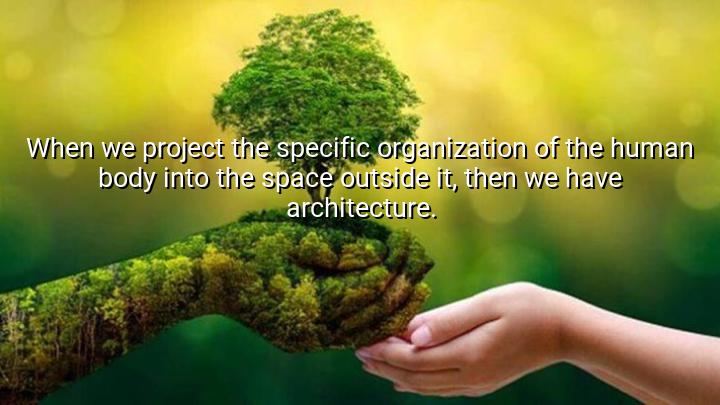




The quote by Rudolf Steiner, “When we project the specific organization of the human body into the space outside it, then we have architecture,” expresses a deeply philosophical view of architecture as an extension of human nature. Steiner, known for his work in spiritual science, anthroposophy, and holistic education, believed that the human body serves as a template for how we shape and understand the built environment. In this perspective, architecture becomes a mirror of the human form, both in proportion and in the way it supports life.
By referring to the “specific organization of the human body,” Steiner emphasizes the importance of order, structure, and organic unity. Just as the body is composed of interconnected systems—skeletal, circulatory, muscular—so too should architecture reflect a cohesive and harmonious design, where form and function are intimately linked. His statement suggests that buildings should resonate with human scale, comfort, and spiritual well-being, not just fulfill mechanical needs.
This idea is central to Steiner’s architectural philosophy, particularly in his designs for buildings like the Goetheanum in Switzerland, which exhibit fluid forms, natural materials, and an absence of rigid symmetry. These designs aim to foster spiritual connection and sensory engagement, rooted in his belief that architecture has the power to nourish the soul just as the body nourishes life. For Steiner, the relationship between the human form and architectural space is not metaphorical—it is foundational.
The origin of this quote lies in Steiner’s broader teachings on spiritual science and design, where he argued that architecture should be informed by the inner nature of the human being. His approach was revolutionary for integrating anthropocentric principles with artistic expression and metaphysical insight. Through this lens, architecture is not just a product of engineering, but a living expression of human consciousness projected into the world.

AAdministratorAdministrator
Welcome, honored guests. Please leave a comment, we will respond soon