

When we are in love we seem to ourselves quite different from what we were before.
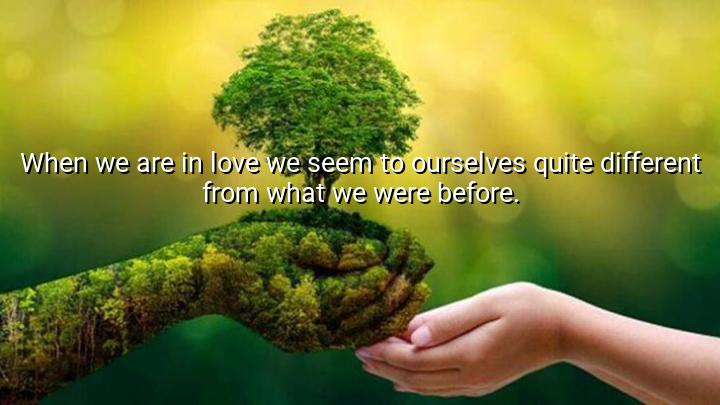




The quote by Blaise Pascal, “When we are in love we seem to ourselves quite different from what we were before,” reflects the transformative effect of love on personal perception and identity. Pascal highlights that love has the power to alter our sense of self, making us feel renewed, inspired, or even unrecognizable compared to our former state. This emphasizes how deeply emotional connections can influence our thoughts, behaviors, and self-awareness.
The origin of this quote comes from Pascal’s work as a 17th-century French mathematician, philosopher, and writer, known for his reflections on human nature, emotion, and the divine. In his writings, Pascal often explored the complex interplay between reason and feeling, and this quote illustrates his understanding of how love can profoundly affect human consciousness, sometimes in ways that transcend rational explanation.
Beyond its literal meaning, the quote speaks to the psychological and emotional transformation that occurs in romantic or deep love. When we fall in love, our priorities, perceptions, and even our self-image may shift. Pascal reminds us that love is not merely a feeling, but a force capable of reshaping our inner world, revealing both vulnerability and growth.
Ultimately, the quote celebrates love as a catalyst for personal change. Pascal’s insight suggests that love allows us to experience life differently, opening our hearts and minds to new perspectives. By recognizing how love transforms us, the quote encourages self-reflection and an appreciation of the ways in which relationships enrich and redefine our sense of self.

AAdministratorAdministrator
Welcome, honored guests. Please leave a comment, we will respond soon