

When the shriveled skin of the ordinary is stuffed out with meaning, it satisfies the senses amazingly.
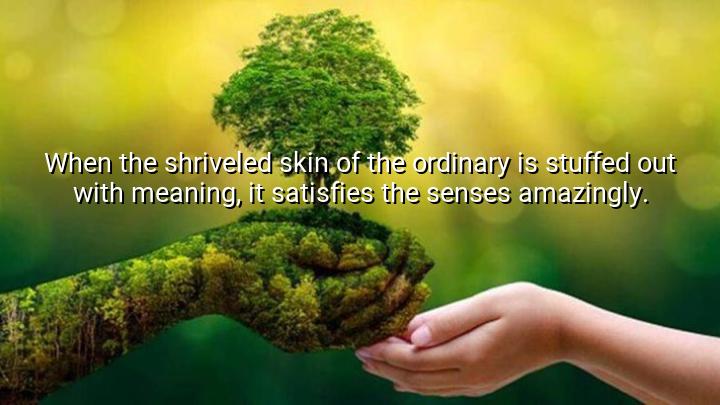




The quote by Virginia Woolf — "When the shriveled skin of the ordinary is stuffed out with meaning, it satisfies the senses amazingly." — explores the transformative power of imbuing the ordinary with depth and meaning. Woolf suggests that when something seemingly mundane or commonplace is given significance, it becomes far more enriching and sensory. The imagery of “shriveled skin” represents the dullness or emptiness that can often accompany everyday experiences, while meaning breathes new life into them, turning them into something far more satisfying.
Woolf’s statement reflects her modernist focus on perception and the subjective experience of reality. As an influential writer, she often delved into the emotional and psychological layers of ordinary life. In this quote, she encourages looking beyond the surface of the ordinary to uncover the deeper layers of significance that can make even the simplest things feel profound. By focusing on the deeper meaning behind everyday moments, we are able to engage more fully with the world around us.
The origin of this quote lies within Woolf's broader literary style, which sought to explore the richness of inner life and perception. In her works, such as Mrs. Dalloway and To the Lighthouse, Woolf often sought to elevate ordinary experiences, transforming them into moments of great introspection and revelation. Her writing invites readers to see beauty in the mundane and to understand that the seemingly ordinary holds great potential for deeper meaning.
Ultimately, Woolf’s quote encourages us to find the extraordinary in the ordinary. It reminds us that by imbuing our daily lives with meaning, we can find satisfaction and beauty in the simplest things, transforming routine moments into profound experiences that engage and satisfy our senses.

GNNguyen Ngoc Gia Nghi
Woolf’s words here are so rich, but I can’t help but wonder—does this perspective require privilege or a certain level of comfort to appreciate? If someone is overwhelmed by survival, stress, or trauma, can they realistically find meaning in the ‘ordinary’? Or is that something that becomes available only when other needs are met? I think it raises questions about accessibility to deeper aesthetic or philosophical experiences.
MTTrinh Minh trang
This quote made me reflect on how memory works—how a smell, a texture, or a small moment can suddenly feel rich with meaning. Do you think our senses are actually more attuned to meaningful experiences than we give them credit for? Maybe we just need to slow down and notice more. I’d love to hear others' examples of ordinary things that became unexpectedly powerful or beautiful.
XTXuan'n Thu'u
There’s something incredibly poetic about this quote, but also something quietly revolutionary. In a consumer-driven world, where we’re encouraged to chase the next best thing, isn’t it kind of radical to find deep satisfaction in something simple or overlooked? I wonder what this means for how we define happiness. Could embracing this mindset be a path to more sustainable contentment?
DNNguyen. Dinh Nam
This quote feels like an invitation to see life differently, but it also makes me wonder—are we responsible for creating that meaning, or are we just discovering what’s already there? And if we’re creating it, how do we avoid the trap of romanticizing things that are actually painful or hollow? It’s a fine line between finding depth and forcing it, and I’m not sure where that balance lies.
HNHieu Nguyen
I find this quote fascinating but a bit abstract. What does it really mean to ‘stuff the ordinary with meaning’? Is that something we do consciously, like assigning value to rituals or routines, or does it emerge naturally when we’re truly present? I wonder how much of this process is emotional versus intellectual. Could this be why artists and writers are often so tuned in to the details others miss?