

When our thousands of Chinese students abroad return home, you will see how China will transform itself.
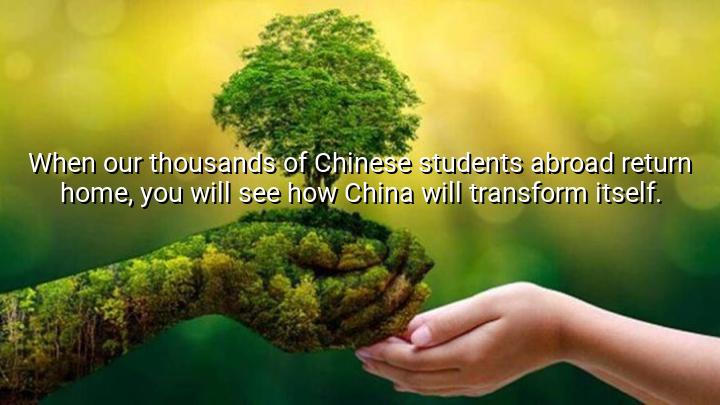




The quote "When our thousands of Chinese students abroad return home, you will see how China will transform itself" by Deng Xiaoping emphasizes the potential of education and global exposure in shaping the future of China. Deng is expressing his belief that the knowledge and experiences gained by Chinese students studying abroad will play a crucial role in transforming China when they return. These students, exposed to different ideas, technologies, and perspectives, will bring new skills and innovations back to China, helping to modernize its economy, society, and institutions.
The origin of this quote is tied to Deng Xiaoping's vision for China's modernization. As the leader of China after the Cultural Revolution, Deng pushed for economic reforms and greater integration with the world. He understood that for China to thrive in the global arena, it needed to develop a highly educated and technologically proficient workforce. This quote reflects his faith in the power of education and international exchange to drive change and progress within China.
Deng’s statement also highlights the idea that global engagement is essential for national growth. By sending students abroad, China was able to expose them to advanced ideas and innovations that could be applied upon their return. This process of knowledge transfer was seen as a way for China to leap forward and catch up with the more developed nations of the world. Deng believed that these students would become catalysts for innovation, contributing to a more dynamic and competitive China.
Ultimately, this quote underscores the importance of education and international exposure in China’s rise as a global power. It reflects Deng’s forward-thinking leadership and his belief in the transformative potential of educated, globally-minded individuals. The return of these students was seen as a crucial part of China’s ongoing economic and cultural transformation during the late 20th century.

AAdministratorAdministrator
Welcome, honored guests. Please leave a comment, we will respond soon