

When love is gone, there's always justice. And when justice is gone, there's always force. And when force is gone, there's always Mom. Hi, Mom!
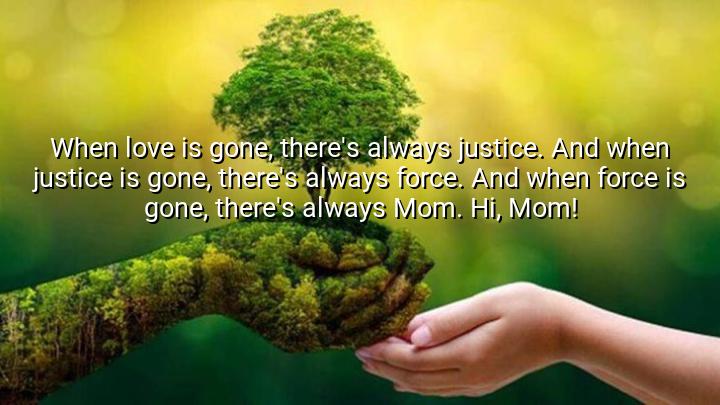




Laurie Anderson's quote explores the evolution of conflict and the human need for support. The progression from love to justice to force represents different responses to problems as they intensify. Anderson suggests that when love fades or is no longer enough to resolve an issue, justice steps in as a more structured, but still fair, solution. When justice fails or is unavailable, force is often used as a last resort, a more aggressive means of maintaining order or achieving goals.
The final shift to Mom serves as a poignant and humorous twist. Anderson implies that, no matter how difficult or chaotic life becomes, there is always comfort and unconditional support to be found in family—specifically, in a mother's love. The phrase "Hi, Mom!" adds a lighthearted and personal touch, emphasizing that even in the most challenging times, a mother's presence is a constant source of refuge and reassurance.
By linking the concepts of love, justice, and force to the idea of family, Anderson underscores the importance of emotional bonds in dealing with life’s difficulties. It suggests that, no matter how far we move from peaceful resolutions (like love and justice), there is always a safe haven in familial care, especially a mother’s love. It highlights how these relationships serve as a grounding force when external solutions fail.
In essence, Anderson’s quote speaks to the unwavering support of family, particularly a mother, as a stabilizing force in times of personal or societal turmoil. It is a recognition of how the love and wisdom of a mother can offer clarity, grounding, and comfort in an increasingly chaotic world.

AAdministratorAdministrator
Welcome, honored guests. Please leave a comment, we will respond soon