

When I first started coaching, one of the worst things that I think I heard was 'It will be O.K.' I would wonder, 'How the hell is it going to be O.K.?' The worst word in the English language is 'hope.'
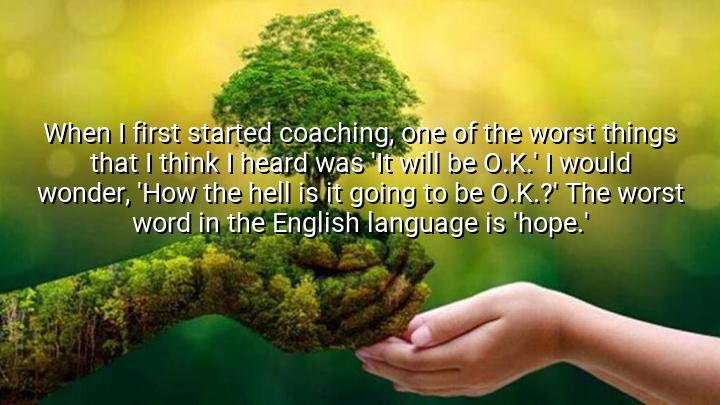




In this quote, Bobby Knight, a legendary college basketball coach, reflects on his early experiences with coaching and his frustration with the word "hope." He highlights how hearing "It will be O.K." felt dismissive and unhelpful, as if it were a way to avoid taking responsibility or making a real plan. Knight expresses his belief that hope, when used as a substitute for action or problem-solving, is ultimately ineffective and doesn't lead to meaningful results. Instead, he values practical solutions over optimism without substance.
Knight's perspective on hope reflects his no-nonsense, results-oriented coaching philosophy. As a coach, he emphasized hard work, discipline, and strategy, believing that relying on hope could lead to complacency or a lack of focus on action. To him, hoping that things will improve without putting in the necessary effort was counterproductive and an obstacle to success. His emphasis on tangible efforts over hope reflects his belief that effort and determination are the true keys to achieving goals.
The quote also reflects a broader critique of wishful thinking or passive optimism in both sports and life. Knight suggests that people often use hope as a way to avoid confronting difficulties or taking initiative. He implies that hope can be dangerous when it leads to inaction or a failure to plan and prepare properly. His frustration with the word "hope" reveals his commitment to an approach grounded in control and effort, where outcomes are shaped by what you do, not what you wish for.
Ultimately, Knight’s statement challenges the idea that hope alone can create success. Instead, he advocates for a mindset focused on action, discipline, and hard work. It’s a call to move beyond empty optimism and to take charge of your circumstances, making deliberate choices to ensure that things will indeed be "O.K." through real effort, not just the hope that they will improve on their own.

AAdministratorAdministrator
Welcome, honored guests. Please leave a comment, we will respond soon