

Whatever is done for love always occurs beyond good and evil.
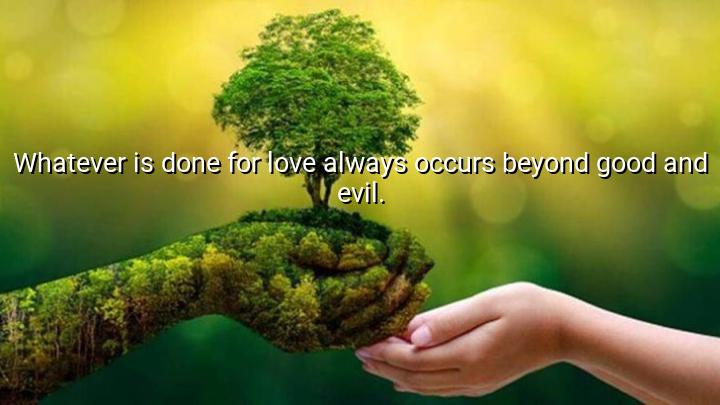




The quote "Whatever is done for love always occurs beyond good and evil" by Friedrich Nietzsche explores the idea that love transcends the traditional moral frameworks of good and evil. Nietzsche suggests that actions driven by love operate in a realm where moral judgments like right and wrong no longer apply. Unlike actions motivated by self-interest, fear, or duty, love is a force that surpasses conventional ethical boundaries, often leading people to act in ways that may seem irrational or unconventional, but are deeply rooted in a pure emotional or spiritual drive.
In this context, Nietzsche is challenging the idea that morality should be confined to societal rules and judgments of good versus evil. He argues that when people act out of love, they are no longer bound by these moral constraints, because love operates on a more profound, intuitive level. Love becomes a transcendent force that liberates individuals from the constraints of conventional moral systems, allowing them to act freely and authentically, even if their actions are seen as contrary to societal norms or ethical standards.
The origin of this quote is found in Nietzsche's philosophy, particularly in his work Beyond Good and Evil (1886), where he critiques traditional moral values and explores the idea of amor fati (love of fate). Nietzsche believed that traditional Christian and philosophical views of morality were limiting, and he proposed a new understanding of human experience that embraced individual freedom, creativity, and the will to power. This quote encapsulates his radical rethinking of morality, where love, as a deep and authentic emotion, exists outside the confines of judgment and ethical dichotomies.
In essence, Nietzsche’s statement invites us to see love as a force that operates beyond moral boundaries. It suggests that when people act from a place of genuine love, their actions become unbound by the usual judgments of right and wrong. By embracing this, individuals are encouraged to explore their own deeper humanity, not defined by external moral codes, but by the transformative power of love itself. It challenges us to reconsider the limitations we place on our actions and to see the potential for love to redefine our understanding of what is truly good and evil.

AAdministratorAdministrator
Welcome, honored guests. Please leave a comment, we will respond soon