

What we want is to see the child in pursuit of knowledge, and not knowledge in pursuit of the child.
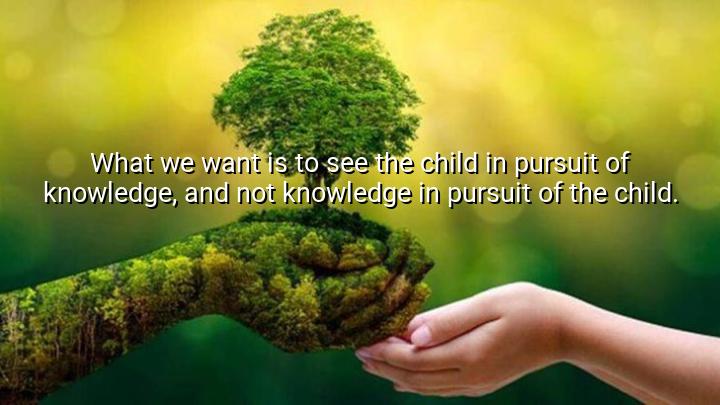




George Bernard Shaw’s quote emphasizes the importance of child-centered learning. When he says, “see the child in pursuit of knowledge”, he envisions education as a process driven by the child’s curiosity and natural desire to learn. In contrast, the idea of “knowledge in pursuit of the child” suggests a rigid, imposed system where information is forced upon students, often without regard for their interests or readiness. Shaw is arguing for an educational philosophy that prioritizes exploration, discovery, and intrinsic motivation over rote instruction.
The origin of this quote can be traced to Shaw’s broader views on education reform and individual development. As a playwright and social critic, Shaw was deeply engaged with questions about society, progress, and the role of institutions. His critique of traditional schooling reflected his belief that education should nurture creativity rather than suppress it. This perspective was influenced by progressive thinkers of his time who challenged conventional teaching methods and sought more humane and effective ways of fostering intellectual growth.
The meaning of the quote also lies in its advocacy for respecting the individuality of children. Shaw suggests that true education empowers children to ask questions, seek answers, and develop their own relationship with knowledge. Instead of treating learners as passive recipients, he highlights the importance of cultivating a sense of agency and ownership in learning. This aligns with modern educational theories that stress inquiry-based learning, where students actively construct knowledge through experience and engagement.
Ultimately, Shaw’s words remain a timeless reminder that education should inspire, not impose. His quote critiques rigid, one-size-fits-all schooling and instead promotes an approach that encourages children to become lifelong learners. By focusing on the pursuit of knowledge rather than the mechanical delivery of facts, he underscores that the true purpose of education is to awaken the human spirit to curiosity, creativity, and growth.

AAdministratorAdministrator
Welcome, honored guests. Please leave a comment, we will respond soon