

What is history? An echo of the past in the future; a reflex from the future on the past.
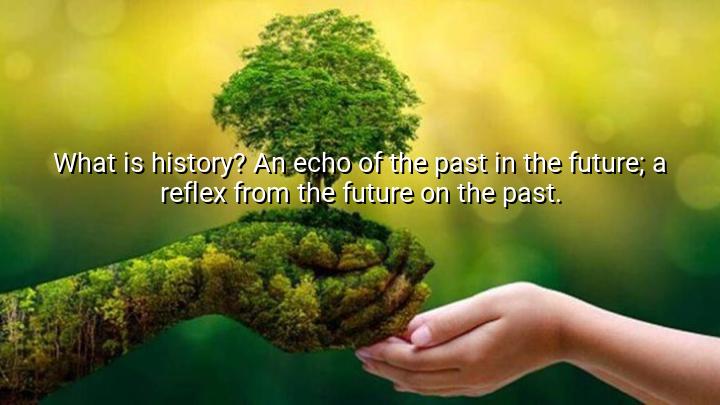




The quote "What is history? An echo of the past in the future; a reflex from the future on the past" by Victor Hugo offers a philosophical take on the nature of history and its relationship with time. Hugo suggests that history is not just a static record of past events, but rather a dynamic, evolving process where the past continually influences the future, and the future in turn shapes our understanding of the past. This cyclical relationship between past and future emphasizes that our interpretation of history is constantly in flux.
The first part of the quote, "an echo of the past in the future," implies that the events of the past reverberate into the future, influencing the course of human development, culture, and societal evolution. In this sense, history is something that doesn't merely reside in the past but continues to affect future generations, shaping their actions, decisions, and perceptions.
The second part, "a reflex from the future on the past," adds another layer to Hugo's view, suggesting that our understanding of the past is also shaped by the future. As time progresses, new perspectives and insights often emerge, altering the way we view past events. This reflexive process implies that history is not only a reflection of what has already happened but also a fluid construct that is shaped by our evolving understanding and circumstances in the future.
Ultimately, Hugo’s quote challenges the traditional view of history as a fixed, linear timeline. Instead, he presents it as an ongoing interaction between the past and the future, where each influences and redefines the other. This perspective encourages a deeper, more nuanced approach to history, recognizing that it is shaped not just by what happened, but by how we interpret and understand those events as we move forward.

AAdministratorAdministrator
Welcome, honored guests. Please leave a comment, we will respond soon