

What is great in man is that he is a bridge and not a goal.
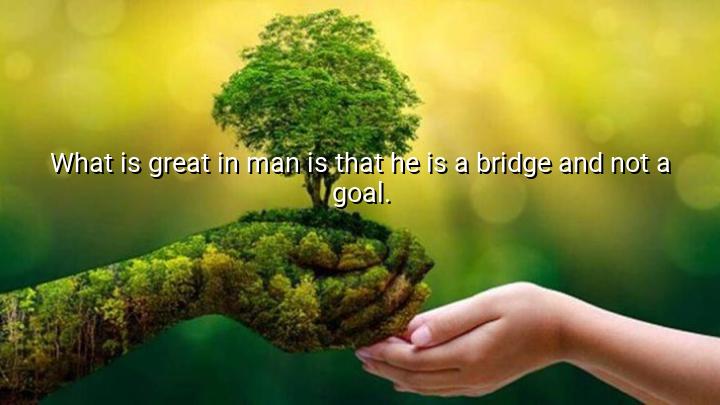




Friedrich Nietzsche’s quote, "What is great in man is that he is a bridge and not a goal," reflects his philosophical view on human existence and self-realization. Nietzsche suggests that the greatness of humanity lies not in achieving a static end-point or final goal, but rather in the potential for growth and transformation. The metaphor of a bridge represents a process—an ongoing journey—that connects different phases of existence, rather than focusing on a fixed destination.
In Nietzsche’s view, humans are not meant to be confined by rigid goals or definitions of success. Instead, they should embrace the idea that growth is continuous and dynamic. The bridge symbolizes the passage through various experiences, challenges, and possibilities, encouraging individuals to transcend their current limitations and move toward a higher form of being. This perspective aligns with Nietzsche’s broader philosophy of becoming rather than being, where the emphasis is on evolution and the potential for greatness within everyone.
The idea that humans are a bridge rather than a goal also connects to Nietzsche’s notion of the Übermensch or "superman." The Übermensch is not someone who reaches an ultimate goal, but rather a person who continuously evolves, creating new values and finding meaning in the process of becoming. In this way, the quote speaks to self-overcoming—the act of constantly challenging oneself and striving toward an ideal that is always in the making.
Ultimately, Nietzsche’s quote encourages a shift in perspective, suggesting that greatness is found in the journey itself, in the ability to transcend limitations and transform over time. It invites us to embrace the idea that human potential is a constant work in progress, and that what is most great about us is our capacity to become more than what we are.

AAdministratorAdministrator
Welcome, honored guests. Please leave a comment, we will respond soon