

What is government itself but the greatest of all reflections on human nature?
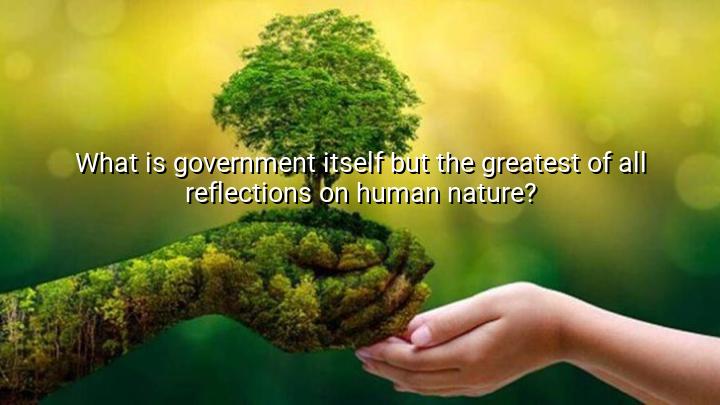




The quote by James Madison reflects the idea that government is a mirror of human nature, showcasing both the strengths and flaws of individuals and societies. Madison is suggesting that the structure, actions, and behaviors within a government reflect the underlying traits of human beings—our desires for power, control, fairness, and sometimes corruption. The way a government operates, whether it’s based on ideals of justice or marred by inequality, is ultimately a product of the people who create and sustain it.
Madison's statement highlights the imperfections of human nature that inevitably influence the creation and functioning of governments. He believed that governments are not purely rational or perfect institutions, but are shaped by the same faults and virtues found in individuals. In this sense, government is both a reflection of human aspirations for order and justice, as well as our weaknesses, such as the temptation for self-interest and tyranny.
The origin of this quote can be traced to Madison’s writings during the founding of the United States, particularly his contributions to the Federalist Papers. As a key figure in shaping the U.S. Constitution, Madison was deeply concerned with balancing human nature—the tendencies toward ambition and power—against the need for a stable and just government. His thoughts on checks and balances were rooted in his understanding that government must account for the inherent flaws in human nature.
In essence, Madison's quote underscores the complexity of government as both a reflection of and a response to the nature of the people it governs. It suggests that the structure of government must account for human strengths, but also the flaws that might lead to injustice and corruption. His perspective encourages a more critical examination of how human nature influences the formation and functioning of political systems.

AAdministratorAdministrator
Welcome, honored guests. Please leave a comment, we will respond soon