

What is food to one man is bitter poison to others.
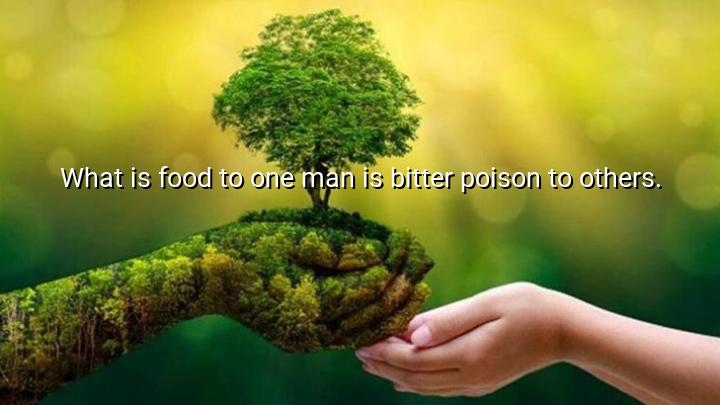




This quote by Lucretius, an ancient Roman poet and philosopher, reveals a timeless observation about the subjective nature of human experience. When he states, “What is food to one man is bitter poison to others,” he is highlighting the idea that what benefits or pleases one person can be harmful or unpleasant to someone else. This applies not only to physical nourishment but also metaphorically to ideas, beliefs, and lifestyles—emphasizing the diversity of human tastes, tolerances, and values.
At its core, the quote reminds us of the principle of relativity in perception and experience. Just as certain foods can cause allergies or discomfort in some while being perfectly enjoyable to others, so too can moral, cultural, or philosophical viewpoints be embraced by some and rejected by others. Lucretius uses this imagery to reflect on the broader inconsistencies in human nature and the importance of individual perspective.
The origin of this quote is found in Lucretius’s epic poem De Rerum Natura (On the Nature of Things), which blends Epicurean philosophy with poetic form to explain the nature of the universe. His work sought to liberate people from superstition and fear, urging them to understand the world through reason and observation. This quote reflects his philosophical emphasis on naturalism, individual variation, and the idea that truth and value are not one-size-fits-all.
Ultimately, Lucretius’s words serve as a powerful metaphor for tolerance and self-awareness. They encourage us to respect the fact that what works for us may not work for others, and that wisdom lies in recognizing and honoring that difference. His insight remains profoundly relevant in today’s diverse and interconnected world, where empathy and understanding are more vital than ever.

AAdministratorAdministrator
Welcome, honored guests. Please leave a comment, we will respond soon