

What I have tried to show is that the scientific attitude implies what I call the postulate of objectivity - that is to say, the fundamental postulate that there is no plan, that there is no intention in the universe.
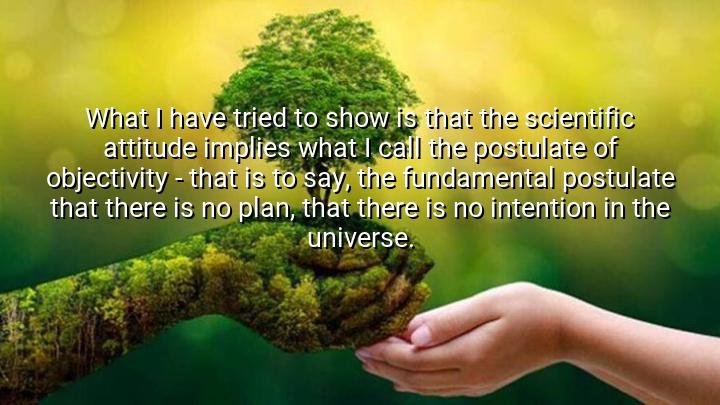




The quote "What I have tried to show is that the scientific attitude implies what I call the postulate of objectivity—that is to say, the fundamental postulate that there is no plan, that there is no intention in the universe." by Jacques Monod encapsulates a core principle of the scientific worldview: the universe operates without inherent purpose or design. Monod, a French biologist and Nobel laureate, was instrumental in advancing molecular biology and is known for his reflections on the philosophical implications of science, particularly in his book Chance and Necessity.
Monod’s postulate of objectivity refers to the scientific commitment to observe and understand phenomena without assuming any predetermined purpose or teleology. This means that science seeks explanations based on empirical evidence and natural laws, rather than attributing events to a divine plan or intentional design. By stating there is “no plan” or “intention,” Monod emphasizes that the universe is indifferent to human existence, operating through chance, necessity, and physical processes.
This perspective challenges traditional religious or metaphysical views that ascribe meaning or purpose to the cosmos. Monod argues that accepting this lack of inherent design is essential to maintaining scientific rigor and honesty. His view urges us to confront the randomness and contingency of life, recognizing that our existence is a result of natural processes, not predestined outcomes.
Ultimately, Jacques Monod’s quote is a profound reflection on the nature of reality as revealed by science. It invites us to embrace an objective, evidence-based understanding of the universe, while acknowledging the existential implications of a world without intrinsic purpose. This postulate serves as a foundation for scientific inquiry and a challenge to human notions of meaning and destiny.

AAdministratorAdministrator
Welcome, honored guests. Please leave a comment, we will respond soon