

What can be more foolish than to think that all this rare fabric of heaven and earth could come by chance, when all the skill of art is not able to make an oyster!
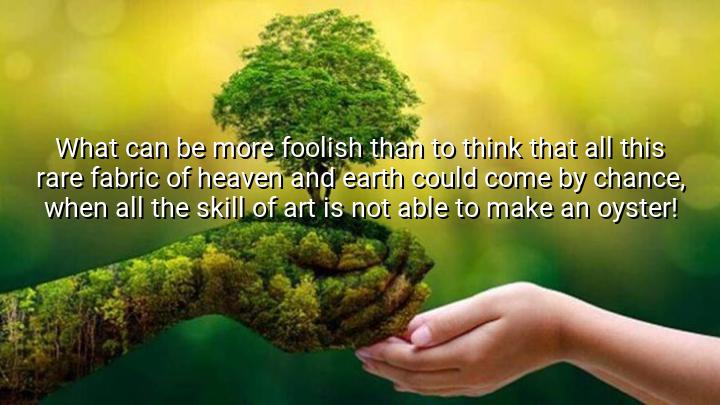




In this quote, Anatole France critiques the idea that the complex and intricately designed world we live in could have come into existence by mere chance. He argues that the fabric of heaven and earth—the vast and wondrous natural world—could not have emerged without some form of intelligent design or purpose. The reference to art and skill highlights the contrast between human craftsmanship and the magnificence of nature, pointing out that even with all of human creativity, we cannot replicate something as simple as an oyster, a humble yet intricate creation of nature.
France uses the example of an oyster to illustrate how even the simplest of natural creations requires a complex process, which, according to him, could not arise from random chance. He implies that the incredible complexity of life and the universe—its beauty, order, and intricacy—suggests a higher power or intelligent force behind it, rather than a mere accident. The quote challenges those who believe in randomness or naturalism alone as the explanation for the existence of life.
The phrase "all this rare fabric of heaven and earth" conveys the grandeur and complexity of the natural world, from the heavens to the earth itself, suggesting that its beauty and order cannot be the product of mere coincidence. France’s point is that there is a certain level of craftsmanship in nature that cannot be easily dismissed, which reinforces his belief in some form of design behind creation.
Anatole France was a renowned French writer and philosopher, known for his skeptical views on religion and traditional beliefs. This quote reflects his tendency to question prevailing ideas and emphasize the complexity of the world, encouraging deeper thought about the nature of existence. While France was often critical of organized religion, he used this quote to provoke reflection on the possibility of a higher intelligence behind the universe's design.

AAdministratorAdministrator
Welcome, honored guests. Please leave a comment, we will respond soon